
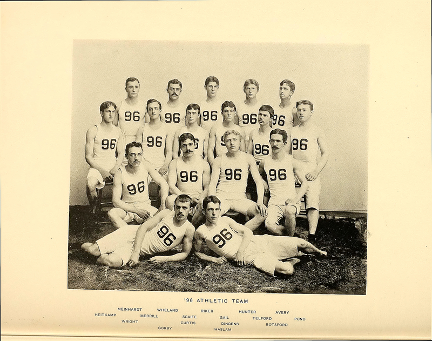
Carl Dingens (team photo), Row Two, Blonde hair, second from right
Carl L. Dingens, Cornell 1896: Carl Louis Dingens died in Buffalo on April 30, 1927..He was born in Buffalo March 22, 1873, the son of Joseph A. and Julia G. Dingens. He attended Canisius School in Buffalo,and entered Cornell in 1892, graduating in 1896 with the degree of M. E.nFor the last ten years of life he had been superintendent of the American Pad and Paper Company of Holyoke, Mass. Previously he had been an officer in the A. Hussey Leaf Tobacco Company and L. B. Sutter and Bros., Inc., also a leaf tobacco company. He was survived by his wife, Mabel E. Hobbs Dingens, and a son, Carl H. Dingens. He was the inventor of a type of patented printers’ quoin.
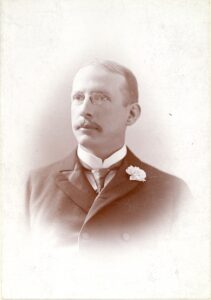
Photo: Elmira criminal attorney John B. Stanchfield, Mark Twain’s distinguished friend from Elmira, NY. For film rights to this documentary story, contact Hank Nuwer at Hjnuwer@Alaska.edu
A Hazing Death: Human Rights and the Constitutional Right to Remain Silent: The Death of Henrietta Jackson Was Negligent Homicide: a Planned, Irresponsible Stunt…Not an Accident. by Hank Nuwer
Cornell University sponsored a gala inauguration for President Jacob G. Schurman on November 11, 1892. The faculty and students applauded and stomped the floor. Fifteen months later, a Cornell student, in collusion with other confidantes, killed an innocent woman in a hazing incident. Here is the story of that death.
The traditional freshman dinner began on the fourth floor Masonic Hall banquet room with toasts by the freshmen officers. A kitchen adjacent to the hall was used for food preparation. Henrietta Jackson, a sturdy African-American cook, stood shoulder-to-shoulder with a white cook in the massive kitchen adjacent to the banquet hall. They prepared the menu choices: blue point oysters, a bouillon soup, filet of beef smothered with Champignon mushrooms, potato croquets, escalloped apples, and lobster salad. As they labored, a prankster from the sophomore class plotted his next move from an empty office on the third floor. Days earlier, he and his co-conspirators had staked out this room situated under the banquet hall and used an augur to drill two holes in the ceiling.
A little after 11 p.m., the perpetrator connected rubber and glass tubes to two empty, dark-colored jars that once had stored soda-fountain syrup. The jars contained chlorine made with commercial potash and other ingredients found in any mercantile store. He pumped the chlorine into what he thought was the banquet room, but instead went into the kitchen.
The attacker vanished into the snowy night, believing he had succeeded in disrupting the banquet and left nothing to trace him.
The menacing gas overtook Henrietta Jackson and the kitchen workers, some of them moonlighting students.
A server named John from Utica, New York, gasped for air. “I have got to get out of the room,” John complained, wheezing.
Henrietta Jackson wheezed. The cook had been working alongside the stove longer than anyone, including her daughter Mary Matilda Jackson on the opposite side of the kitchen. Mary had been minimally affected, but her mother proved sensitive to chlorine poisoning.
Upperclassmen Thomas McNeil, III, and another youth, who were serving as sentries for the freshman class to keep out invading sophomores, raced into the kitchen to render assistance, but they too were overcome by fumes. McNeil, an outstanding athlete, suffered severe short-term and longterm respiratory issues after the chlorine incident.
A worker who recognized the scent of chlorine purchased a vial of ammonia in the open store and raced back into the kitchen. The savior with the ammonia pressed some to the cook’s lips with a handkerchief t to revive her.
Warren Kenyon, by day a clerk at Platt & Colt’s Drug Store, was on cleanup duties in the kitchen. Mary Matillda Jackson called to him that her mother needed assistance. The woozy Kenyon assisted Mrs. Jackson down the stairs. They fell at the bottom and other rescuers took her by the arms into the street. “She seemed to be very still and quiet,” said Kenyon later. “[Mrs. Jackson] walked right along quiet, and apparently had her eyes shut, I thought.”
While the Cornell Class of ‘Ninety-Seven remained in the hall and toasted one another with Roman punch, Mrs. Jackson’s bleached lungs failed her. A rescuer took Mrs. Jackson to Dr. Walter Lockerby’s home office at 26 East Seneca Street. She stumbled along the way. The physician and surgeon was an ear, nose, and throat specialist.
Just before midnight. Dr. Lockerby answered the doorbell and let Mrs. Jackson and the rescuer inside. She collapsed in the chair nearest to the door and asked for water. Her suffering was immense. Her reddish cheeks signified that her brain and heart were oxygen-deprived. The physician recognized the distinctive odor of chlorine that he used to sanitize his office. Mrs. Jackson managed to take swallows of water. Dr. Lockerby snatched her arm. Her pulse was imperceptible. She clearly was asphyxiating. Her shallow breaths made it apparent that she was at the point of death. The rescuer went back to Mrs. Jackson’s daughter.
The physician tried to revive her heart adminsterng a teaspoon of digitalis squills, glycerin, and water. When that treatment failed, he forced ammonia spirits into her. The doctor’s wife Edith scrambled out of bed to offer assistance, but the end was at hand.
Mrs. Jackson’s body relaxed, and she sank back into the chair. It had taken five minutes, after she had entered the house, for her to die. Dr. Lockerby and his wife placed her body flat on the floor and tried to revive her.
Mary Matilda Jackson arrived. She witnessed her mother’s corpse on the floor. She ran home to summon her father William.
After the gas subsided, kitchen workers returned while the banquet still reigned, there to be interviewed by Ithaca night sergeant John Edgar Clapp. Clapp was a retired professional baseball catcher. The next morning, Clapp and a second officer traced the tubes from the kitchen to the source. The door’s room had been barricaded, and they had to gain entry by smashing a hole in a door panel. They found boxes with identifying labels and some tin wires hidden in a long stove used to heat flat irons. They also located the chlorine jugs stashed behind a sign.
A local paper covered the death one day after the attack. Their reporting embarrassed Cornell’s administrators. President Schurman promised that the instigators would be punished. The initial newspaper coverage, edited in the wee hours, proved woefully inaccurate. The Ithaca Journal mistakenly reported that daughter Mary Matilda Jackson, not Henrietta Jackson, had been killed. Newspapers as far away as Missouri, incorrectly announced that student worker Thomas McNeil, III had died with Mrs. Jackson.
It took a day before the Ithaca papers correctly identified Mrs. Henrietta Jackson as the deceased victim. The cook was survived by Mary, William, and an elderly mother. An Ithaca newspaper printed a brief correction acknowledging that McNeil and the other student were alive and recovering. However, much coverage disenfranchised Mrs. Jackson. Papers described her as an overweight, elderly “colored woman” with a bad heart. One of the most disturbing aspects about Jackson affair is that out of thousands of ensuing news stories, few, if any reporters interviewed the cook’s surviving husband and daughter.
Because Mrs. Jackson’s death was a homicide, a coroner’s jury was empowered to find the individuals responsible. In charge was J. Watson Brown, M.D., a local physician who had been elected Tompkins County coroner in 1892. The grand jury was charged with determining if murder charges could be brought against the person or persons whose “act evinced [a] depraved mind, regardless of human life,” noted the Ithaca Journal on February 24, 1894.

A handful of Cornell class officers took up a collection to purchase an Ithaca City Cemetery grave marker.
Mrs. Jackson’s funeral was held February 24, 1894, at the M. E. Zion Church. Many Cornell students attended the funeral. Seating was standing room only. Pastor J. H. Callis denounced the killing that happened because arrogant individuals took it as their due to make sport at the expense of others.
An autopsy destroyed the Ithaca Journal’s unmerited insinuations regarding the victim’s old age and poor health. Dr. Martin Besemer, age 46, who performed the post-mortem examination, swore at the inquisition that Mrs. Jackson was extraordinarily healthy and had the internal organs of a much younger woman. She was only fifty-three years old, not elderly. He found no sign of disease, he testified in the inquiry conducted by coroner’s jury foreman D. F. van Vleet, Esq., a Cornell alumnus, Chi Psi fraternity alumnus, and Democratic Party leader.
The only sign of aging at all was in the left lung where the doctor found “a slight degree [an inch in diameter] of some calcareous matter.”
“Was that deposit sufficient to have caused death? asked van Vleet.
“No, not sufficient probably,” said the doctor. The lungs did show evidence of congestion that “could have been” due to the chlorine, however. He went on to say that either smoke from the stove or an irritant gas caused her death. Jackson’s lungs had filled with clotted blood.
“The heart was an extraordinary specimen . . . for a woman of that age?” inquired van Vleet.
“That is the conclusion we came to,” Dr. Bessemer testified.
Testimony at the Inquest
Witness Edwin Gillett, a clerk at C. J. Rumsey & Company hardware dealers, testified at the inquisition. “A young man, clean face I should say, about seventeen to eighteen,” had walked into the store to purchase an augur for boring holes. He came back and talked to another clerk, saying it was too short at about six inches, and he wanted to trade for a longer one. Gillett told the inquiry that he wasn’t sure if he would be able to identify the purchaser.
The inquiry called Hiram Haskins, a druggist at 6 East State Street in Ithaca, and showed him some wrapping paper in a package bearing a 6 Cook Street address. He did not know who had purchased the package but was certain it contained a half-pound of permanganate of potassium, an antiseptic and disinfectant used to make chlorine. He assumed the buyer was a student. The two had a conversation about making chlorine. Haskins said he could not identify who had poisoned Mrs. Jackson.
The jury interviewed tailor Charles F. van Houten who worked in a suite opposite the office where the gas had been released. He said several young men had been running in and out of that room for one week. He hadn’t confronted them. He heard no sound in that room the day of the banquet. The perpetrator had operated with stealth. The testimony showed this was a planned ambush with careful planning for weeks, not a spontaneous act of hazing and NOT an accident. Although the perpetrators went on to live their lives, their unconscionable hazing stunt killed Mrs. Jackson and may have shortened the life of Thomas McNeil, III. McNeill, once robust at the time of the chlorine crime, was to die an early death just eleven years after the chlorine hazing incident at Cornell University.
One or all involved got away without a conviction despite committing involuntary manslaughter.
Avoiding the Inquest
Based on testimony and investigations by Ithaca police, a list of suspects was put together by prosecutor J. H. Jennings.
The coroner summoned six students who lived at the 6 Cook Street boarding house. Local newspapers named the sophomore roommates Carl L. Dingens of Buffalo and Frederick Taylor of Plainfield, New Jersey. Suspicion arose when the coroner was unable to locate them. A Cornell special student who lived at the Cook Street boarding house testified that Dingens was absent from the house for two days. Taylor turned out to be avoiding reporters at his Phi Kappa Psi fraternity house.
Prime suspect Carl Louis Dingens was the son of Joseph Dingens, a Buffalo, New York merchant known for his marketing skills. Together with his brother, Joseph ran the Dingens Brothers store at 333 Main Street in Buffalo, peddling wine, liquors, cigars, mineral waters and food products. Joseph Dingens owned a five-bedroom house with three bathrooms on Buffalo’s fashionable Park Street.
Carl Louis Dingens at Cornell
Young Dingens belonged to Cornell’s Scalp and Blade society, made up entirely of Western New Yorkers. He participated in Cornell athletic contests, although not in intercollegiate competition.
Reporters for the Buffalo Evening News camped outside the Dingens home on Park Street. A daughter who answered the door said her brother had been in Buffalo a few hours earlier, but an uncle denied that he had been home. He had been home, Carl Dingens later confirmed in his testimony at an inquest.
Two days later, a reporter talked to Taylor, learning that Carl Dingens was off to Syracuse, New York, by train to meet one of his four sisters. Another morning newspaper corralled Eugenia Dingens, Carl’s sister, for an interview. This Miss Dingens, an actress active in community theater, repeated the story that her brother was visiting an invalid sister.
The story about visiting his sister was an untruth, Dingens later admitted under oath. He claimed he had gone to Syracuse for a medical issue with his eyes, and that his doctor told him to rest his eyes and avoid reading newspapers.
Shortly thereafter, local police placed Dingens and his friends C H. Mitchell of New York City, and Charles B. Gorby of Pittsburgh, in custody for failing to cooperate. Frederick Taylor of Plainfield, New Jersey, a notable glee club singer, and Earl Stimson, a student aspiring to become a railroad engineer, cooperated with authorities—but only to a point. Newspapers pointed to what seemed a blueblood wall of silence.
Mitchell, only recently arrived in Ithaca, was not a Cornell student. He refused to answer the jury’s inquiry whether he had been in the Masonic Hall at the time of the poisoning, but he admitted acquaintanceship with Dingens, Taylor and Gorby. He conceded to familiarity with the dry goods company of New York’s James McCreary & Co., whose wrapping paper was found on the abandoned clothing box in the Masonic Block. The box had Mitchell’s name and initials and address on the label. Mitchell had admitted to the Ithaca Journal that the package was his.
The foreman of the coroner’s grand jury attacked Mitchell with a barrage of questions, but the witness refused to out the perpetrators or to reveal their involvement.
Sophomore Charles B. Gorby appeared before the coroner’s jury. He too refused to answer questions about how the chlorine entered the Masonic Hall kitchen.
Foreman: Are you acquainted with Mr. Dingens?
Gorby: I am.
Foreman: Have you been frequently to his room?
Gorby: I should say so.
Pressed whether he had conferred with Dingens and/or Taylor the week before the banquet, Gorby refused to answer.
Another person of interest was Earl Stimson.
One week earlier, on April 24, Earl Stimson had boarded a train in Ithaca that shut down for an emergency stop. Cornell junior James Harry Root, realizing he was on the wrong train, leaped off at 30 m.p.h., and was swept under the wheels, ripping off one leg and most of another. Ithaca sheriff Charles S. Seaman was on the train and asked if Stimson could assist Root. Stimson rushed to the hospital with Root, sitting at his bedside until the victim died. After Root’s mother and sister came to the hospital, Stimson comforted them as well.
Stimson finally gave his testimony to foreman Van Vleet on March 1, 1894. The sophomore student acknowledged that he was a friend and neighbor of Dingens. He had been downtown while the banquet transpired, but he swore under oath that he had not been in the Masonic Hall that fatal day. He refused to answer whether he had discussed ways and means of breaking up the freshman banquet. He refused to answer the follow-up questions posed by the district attorney.
Stimson refused, “on advice of counsel,” to share any facts that might “throw any light” on the criminal act at the freshman banquet. He said he was obeying instructions from counsel.
Faulty Newspaper Reporting
As reporters covered the “Jackson Affair,” the oft-repeated term for death of “the colored woman,” they wrote that a confession soon would come from a perpetrator. “One of the Cornell students will make a clean breast,” promised an Ithaca paper.
Predictably, the faculty of Cornell condemned the death of Henrietta Jackson but maintained the matter was to be investigated by officers of the law, not by professors and deans. The Ithaca paper quoted Professor Charles A. Collin of the Cornell Law School who believed individual or individuals who had caused Henrietta Jackson’s death showed a “depraved mind.” However, given that the chlorine death of Mrs. Jackson was an unintended consequence, Collins thought the offense might prove eventually to be ruled involuntary homicide. Even so, it likely would bring a conviction and a mandatory prison sentence.
On March 1 the Coroner’s jury played hardball. With Carl Dingens in hiding, the jury tried squeezing the truth out of his roommate Frederick Taylor, but the latter refused even to acknowledge that Dingens was his roomie. “I refuse to answer, by advice of my counsel,” Taylor told the jury.
At that point, Taylor’s attorney, Myron M. Tompkins, insisted that Taylor was entitled to a Constitutional right to refuse to testify. Whereupon, van Vleet, the foreman of the jury, insisted the lawyer and the press leave the room.
Dingens on the Stand
Carl L. Dingens returned to Ithaca and, at last, responded to his subpoena from the coroner. Foreman D. F. van Vleet began his interrogation with simple questions to which the witness gave short responses. Dingens said hi course was electrical engineering, a popular major at the time in Buffalo, soon to be nicknamed “the City of Light.” He admitted to having taking a chemistry course. He said his counsel was Myron M. Tompkins.
The questions from the foreman became more pointed and Dingens parried them. He refused to say whether he had made certain purchases from stores such as Platt & Colt.
Dingens acknowledged that his father had been in Ithaca as recently as the previous day. He admitted he first heard “that this colored woman was dead” about 7 a.m. on Wednesday morning, February 21.
Van Vleet: Were you one of the parties that helped to manufacture the gas, which was forced into the banquet hall of the Freshman class?
Dingens: I refuse to answer your question.
Van Vleet: Upon the ground that it would tend to criminate you?
Dingens: It might tend to criminate me.
The foreman dismissed Dingens.
The coroner’s jury took testimony from Dr. Lockerby His official medical opinion was that Mrs. Henrietta Jackson perished from “spasmodic contraction of the bronchial tubes” likely caused from inhaling irritant gas.
The jury empowered its collective opinion on March 14, 1894. “The said Henrietta Jackson . . . came to her death on the night of February 20th, 1894, by reason of the inhalation of chlorine or other irritant gas manufactured and introduced into a room in Masonic Block in the City of Ithaca, New York where deceased was at work by a person or persons to this jury unknown.”
Dingens was now the prime suspect in the Jackson affair. The case now went before a grand jury before Judge Gerritt A. Forbes. The judge seemed determined to reject all refusals from those that refused to testify. Worried that his son would be jailed for contempt of court, Joseph Dingens retained Elmira criminal attorney John B. Stanchfield, to help local counsel representing his son and the other defendants. The impeccably dressed Stanchfield was a close friend of Mark Twain. Stanchfield’s wife, the former Clara L. Spaulding, was Twain’s wife’s best friend and twice visited Europe with the Clemens family.
Frederick Luther Taylor, now well coached, invoked his constitutional guarantees to “throw himself upon the privilege . . . on the ground that it may tend to criminate me” on the Murder One charge. This became his standard response to the prosecutor’s questions about the origin of the jugs and about the purchaser of materials used to make chlorine. He almost lost that privilege by admitting he and Dingens had taken a chemistry class and knew the rudimentary steps in creating chlorine.
On March 28, 1894, Judge Forbes sent Frederick Taylor to jail for contempt for refusing to testify in the Mrs. Jackson case. Taylor’s lawyers ran an end around Forbes’ court. They approached a judge in a neighboring county who set Taylor free and allowed him his constitutional rights.
The Party at the Jail
On April 5, Sheriff Charles S. Seaman greeted Frederick Taylor in his jail. “Mr. Taylor, you are released from my custody and are free to leave this place at any time,” said Sheriff Seaman.
With his left hand, however, Sheriff Seaman handed a subpoena as he shook hands with his right hand. Taylor learned that he had been remanded to speak to a grand jury on April 24, 1894.
Before the sheriff dashed off to catch a scheduled train to Rochester, he told Taylor to use his official office for a celebration. Taylor’s fraternity brothers and Cornell friends came over to mob him. These fraternity fellows, glee club friends and sophomore class members celebrated the chance to visit a pal in the pokey. They accompanied him to his cell where he held forth with them for nearly two hours until exiting the building around 6 p.m. “He was in no hurry to leave jail” a local paper headlined its story.
Taylor had one complaint. The faculty had suspended him while he was in jail and unable to take required exams. “I think the faculty was rather hasty and unjust,” he said to the reporter “But I think they will do right by me and reinstate me.”
Conspicuously missing from news coverage now were any words of contrition from Taylor about Mrs. Jackson’s survivors and how he felt about her painful end. Not one of the accused ever showed remorse. Their silence rings loud to this very day.
Taylor predicted rightly that the Cornell faculty had no choice but to reinstate him, and it did so. He was readmitted in good standing to Cornell as a law student. His thesis was titled “The Liabilities of a Municipal Corporation for the Negligence of a Servant.”
Gerrit A. Forbes faced the defendants
Now the legal ball rolled back into the court of Gerritt A. Forbes, the bearded justice of Oyer & Terminer in Ithaca. Frederick Luther Taylor, in his testimony before Forbes, alternated between giving many “I don’t remember” statements and refusing to testify. Taylor remained silent even when Forbes browbeat him and said he wanted Taylor to make a clean breast of matters. “The court takes the responsibility under the laws of this state of squeezing, so to speak, this evidence out,” said Forbes. “Young man, you are directed to return to the grand jury room and to answer any question which is put to you in reference to anything you know about that transaction.” [1]
Taylor, on advice of attorney, defied Judge Forbes and remained mum. A showdown was in the making.
Ably advised by Stanchfield, Taylor triumphed in the case of People ex rel. Frederick Luther Taylor against Gerritt A Forbes, the justice of the New York Supreme Court.
Together with local attorneys for Dingens and Taylor, Stanchfield appeared before Chief Judge Charles Andrews of the court of appeals in Syracuse who blocked the rulings of Judge Forbes. Andrews agreed with counsel that Justice Forbes had stripped Taylor of his civil rights.
In May of 1894, attorney Leary also argued his case with justices from the state’s Court of Appeals on behalf of Taylor’s right to invoke the Fifth Amendment privilege. On May 16, the court ruled that a stay of proceedings was proper. In other words, unless some witness came forth with evidence against Taylor, the case was over. There would be no grand jury indictments. The case lingered on for a little over two months more, but all that remained was posturing. Stanchfield persuaded the New York Court of Appeals to issue an extremely rare “stay of proceedings,” stopping all legal action in the Jackson murder investigation.
In mid-May, the humiliated Justice Forbes acknowledged that the sealed lips of Taylor meant that Mrs. Jackson’s murderer or murderers would never face criminal trial. He thanked the grand jury for its service and dismissed the foreman and members. Not a single newspaper ever put in a statement from Mrs. Jackson’s daughter and husband for their reaction to the disposal of their mother’s case without attributing guilt to any party.
Stanchfield’s Legal Move
Frederick Taylor’s unremitting refusal to offer testimony effectively removed Carl L. Dingens and the other suspects from trial. Based on the circumstantial evidence at hand, and no willing eyewitness to testify, the local prosecutor had no chance for a conviction. The wall of silence lasted all the way to the death of the last ‘Ninety-Sixer. No deathbed confession came from Dingens, Taylor, Stimson or any other.
Likewise, no one came voluntarily forward to make amends with Mrs. Jackson’s descendants. William Jackson announced plans after the funeral of his wife to launch a civil suit
against Carl Dingens and Frederick Taylor, but the case never was tried, perhaps because the $5,000 Jackson sought in damages could quietly be paid him as an out-of-court settlement by the wealthy Joseph Dingens. Not one newspaper published follow-up stories reporting precisely why the civil suit failed to materialize.
Mrs. Jackson’s daughter, Mary Matilda Hedgepath, wife of the late William A. Hedgepath, died in 1929 after a serious illness. She had no grave marker.
The Taylor decision by the New York Court of Appeals was a nineteenth century landmark case for the protection of an individual’s civil liberties The Henrietta Jackson case ended in a cold case, all evidence from the Mason Block office destroyed over time that might have revealed, in our own time, fingerprints and DNA samples to identify the guilty parties.
Carl L. Dingens and Frederick Taylor made up lost work at school and graduated from Cornell University and found professional employment, respectively, in the fields of business and law. Dingens became manager of the New York branch of G. Hussey and Company, leaf tobacco dealers in New York. Taylor pursued a law career in New York City.
Carl Louis Dingens died April 30, 1927. He was the father of Carl H. Dingens and husband of Mabel Hobbs Dingens, daughter of a New York City meat wholesaler. Dingens’ last residence was on Park Street in Buffalo where he grew up, and at his last job he worked as an executive for a stationery company. He had one patent for a stationery binder in 1915 under his name but assigned that patent to the Bigelow Binder Company of New York. After his death, a survivor wrote the alumni association a curt note demanding that all materials relating to Cornell University cease being mailed to the Dingens house. The family had had quite enough news from Cornell, the short letter said.
Joseph A. Dingens died at 71 in 1907. He kept a pleasant journal of events almost all his life. The story of Mrs. Jackson and his own involvement and lawyering up to save his son from prison escaped the pages of his journal. He kept his own counsel.
John B. Stanchfield continued to serve Mark Twain as his personal attorney for many years but also fielded high-profile criminal cases and was written up in newspapers for his extraordinary lucrative client billings. He tried to enter public service in New York but was defeated for New York governor in 1900 and senator from that state in 1903. He died at 66 in 1921.
Frederick L. Taylor practiced law in New York and joined fellow attorney Raymond D. Thurber in a law partnership. As a pastime, the defendant who had refused to sing in court sang with other Cornell alumni all his life in a New York City glee club.
For the final Cornell University graduation celebration in 1896, the outgoing Taylor had been chosen by his classmates to be the toastmaster. The class cheer resounded at commencement for the last time. “’Ninety-Six, Boom-rah-rix, Boom-rah-rix. We are Cornell, ‘Ninety-Six.”
Frederick Luther Taylor, practiced law at 31 Nassau St., and was well known much of his life as a glee club singer.
Henrietta Jackson’s body lies in her Ithaca grave, and the tombstone the Cornell community bought for her is yet readable. Her daughter’s grave is close by, but Mary Matilda’s lacks a headstone.
The last word on the trial went to news correspondent Murray E. Poole of Ithaca, New York. “It is generally believed that the students would have made a clean breast of the whole affair and taken a punishment fitted to the crime as they regarded it—a fine or short imprisonment—but the news saw so much about murder, electrocution, and death chair, that they closed their mouths tighter than an oyster.”
Now in 2026, as hazing deaths continue to plague the educational system, the legal questions remain settled. The moral questions around the death of Henrietta Jackson remain unsettled. I would love to see her story made into a documentary film.
Note from Hank Nuwer: I was able to get coroner records, testimony, etc. during an extended visit to Ithaca, New York and its courthouse, as well as the archives at Cornell University. My one forever regret was that I learned all evidence in the chlorine death of Henrietta Jackson had been long ago discarded, I believe had the tubes and chlorine jugs been preserved, law enforcement and DNA experts could pin Mrs. Jackson’s death on the co-conspirators.