
from “Kurt Vonnegut: The Man in the Hole. A Life of Reinvention.” In-progress bio by Hank Nuwer
Ignore the footnotes. I will format them and place at back of the biography. Hank Nuwer
ONE
It’s an oft-told tale that deserves to be told in full. A janitor at Drake High School in North Dakota carried out orders to burn books judged offensive by the school on November 7, 1973. Into the giant blue furnace went three dozen copies of the Vonnegut novel Slaughterhouse-Five, along with Deliverance by James Dickey, and an anthology with stories by Ernest Hemingway, William Faulkner and James Thurber.
The upshot was the firing of an English teacher who wanted students to think for themselves and to question those in authority. That was why he assigned those books.
Today, whenever Banned Books are discussed, someone is sure to bring up the censorship at Drake High School.
Opposition to teacher Bruce Wayne Severy ((July 16, 1947-April 12, 2007) came from the entire school board, the owners of Drake’s single drugstore, and especially, Karene Duchsherer, the married granddaughter of the school board president.
Karene Duchsherer once had been the local Dairy Princess and competed against contestants at the annual North Dakota State Dairy Fair.
Karene and Mike Duchsherer were solid citizens of Drake, then a town of 700 residents. They farmed but needed to take additional jobs to get the bills paid. Mike delivered coal to businesses and the Drake School for heating its massive furnace. Karene drove grain trucks and school buses. She also worked at the post office.
The controversy originated with Karene’s daughter, tenth grader Kim Duchsherer, who shared her concern about having to read an assigned book with language she considered vulgar.
“Kimberly was a bit of a prissy girl,” opined former Drake student Katy J. Olson in an email to this biographer. “Her mother had a raunchy vocabulary and liked to tell dirty trucker jokes.”
Did some Drake students consider Karene’s frontal assault on foul language in Slaughterhouse-Five hypocritical?
“The irony did not escape notice in our family,” noted Katy J. Olson.
Karene Duchsherer passed her daughter’s concern on to her own mother, Mrs. Ida Kemper, and to Clayton Kemper, her father and clerk of the school board. Drake citizens looked on Clayton as the city’s patriarch.
Duchsherer felt that free speech should take a back seat to the right of a parent to keep “trash” from her child’s eyes and mind. Moreover, she thought that a board had a duty to take the trash away from all students—even from those parents who wanted their children exposed to literature.
At first, Bruce wasn’t worried when the school superintendent informed him about the complaint. “I was more concerned because about half my class could barely read or write,” he said in a phone interview with this biographer.
Clayton Kemper saw no problem. Shut down the book and assign a classic in its place, he said at the board meeting.
That might have ended matters. The board might have buried the books in a storage room. That would have drawn no attention.
A peculiar aspect of the episode is that no single person admitted being the one to suggest throwing the books into a furnace.
“I don’t remember who said we should burn the books, but somebody said it,” board president Charles McCarthy told the press.
It was school superintendent Dale Fuhrman who decided to get rid of the books by burning them. “I gave them to the janitor as I would my wastepaper,” Fuhrman said to a reporter.
Janitor Sheldon Summers said the idea to burn books was not his own. “I work here,” he said. “I only follow orders.”
Some outraged Drake students refused to turn back their copies of Slaughterhouse-Five as the school demanded, so employees searched the children’s lockers and confiscated the books.
As a result, vocal students staged a protest in the high school’s library. These were Severy’s better students, never known as troublemakers, and their parents made them aware of their civil rights.
One of these was Katy Olson, a first-year student whose class was assigned the anthology. Her brother Mark was assigned Slaughterhouse-Five. On their own they read James Dickey’s Deliverance.
“We of course read all three books,” wrote Katy in an email. “We were a literary family with a house full of books. Mark and I protested the burning by staging a sit-in in the library to assert our right to be taught by Mr. Severy.
Drake High School’s administration was highly conservative at a time when student rebellion reached its zenith.
“Mr. Fuhrman was the superintendent and had the pleasure of expelling several of us for dress code and hair length violations,” recalled Katy Olson.
II
Before moving to North Dakota to teach, Californian Bruce Wayne Severy barely made ends meet as a substitute teacher in Southern California. He had published a few poems in little magazines. He also earned an additional pittance as a freelance correspondent for The Guardian, self-described by him as “an independent radical newsweekly.”
On one story assignment, Bruce, accompanied by his wife Sally, told the Long Beach Independent on April 14, 1971, that he’d been kicked, battered and laughed at by Laguna Park cops after he’d flashed his New York City press pass.
Bruce and his wife told one another there must be a safer and kinder place to live and work than Long Beach, California.
That’s when he applied to teach at Drake High School and won an interview with the school board.
The couple envisioned buying a fixer-upper home in Drake for a fraction of what they might pay for a California house. They expected to eat well on farmers’ market vegetables.
Bruce did have a long bushy beard, but so did many males in North Dakota. Drake superintendent Dale Fuhrman even sprouted one to counterbalance his thinning topknot. An outdoorsman, Fuhrman liked to play hard-nosed canasta.
Bruce told the hiring committee he liked to hunt. Fuhrman promised the candidate the two of them could wing-shoot ducks.
The board hired the outdoorsman/English teacher for the fall of 1972. He spent his first year of teaching 9th, 10th, 11th and 12th grade students. He particularly enjoyed teaching the novel Catcher in the Rye by J. D. Salinger. No one complained about Holden Caul field’s profanity. The 1972-1973 school year went without a hitch.
Bruce and his wife visited the farms of students and chatted with their parents. The parents of Katy and Mark Olson reserved a small patch of farmland for them to put a garden.
“He and Sally and their daughter Liz spent many pleasant hours at our farm where they had a garden,” recalled Katy Olson. “They shared many meals and great conversations over the two years they spent in Drake.”
He also hunted and fished with other locals, not just Fuhrman. Sally joined the Buttons and Bows Club, a ladies’ society of homemakers.
Then, things changed from normal to chaos during the 1973-1974 school year.
“It’s true that Bruce and Sally were far too liberal and hip for Drake,” said Katy Olson in an email January 7, 2022. “I’m sure that’s why we befriended them as it was also the case for our family.”
III The Controversy
In Drake, you could belong to any religion you wanted. However, you earned points if you attended the Catholic, Lutheran, Baptist or former United Brethren churches.
“The moral standards are higher than the average community,” the Rev. A. W. Bibelheimer, retired Baptist preacher, told the press.
Residents invited Bruce and his wife to church. The couple thanked them but said they were non-believers.
Atheism and agnosticism didn’t sit well with the citizens, particularly board member Leslie Gerber, a prosperous farmer who once made it known he wanted no wall hangings other than that of Jesus in his house. Gerber raised prize bulls and was respected for his concern for their welfare.
“When his prize Angus bull was struck in the head by lightning, Leslie sank to his knees in cow manure and prayed,” Bruce later would recall in an unpublished essay he wrote about his time at Drake.
Drake farmers like Gerber never understood Bruce’s wish to challenge his students to become thinkers independent of their parents.
Folks named Gerber were common as rabbits in that part of North Dakota. They were hard-working and generous. If a fellow farmer took sick during harvest time, he found a casserole on his front porch while Gerbers took to his fields and gathered the crop.
Nonetheless, there were limits to neighborliness. Woe to anyone who grew too uppity. “It’s the kind of place that before I went out and bought a Cadillac car, I’d ask myself what my neighbor would say about it,” Lyle Bakker, the town’s banker told the press.
Sure enough, Drake folks had plenty to say when the Drake Catholic priest up and bought a lemon yellow Cadillac Eldorado.
IV
The first problem arose when Bruce gave his five-year-old daughter an illustrated sex education book for kids. She showed playmates the pictures. Bruce apologized to some outraged parents and said he’d keep the book at home.
Next, some locals flat libeled Bruce. They said he’d been smoking pot with his students, a calumny he hotly denies. The school board backed Bruce after finding there was nothing to the rumors.
The controversy flared after Bruce assigned his class Kurt Vonnegut’s Slaughterhouse-Five and recommended a popular anthology and James Dickey’s Deliverance for outside reading.
The controversy deepened after Bruce’s class discussed the morality of the British and American bombing of Dresden.
Then the Board found that Slaughterhouse-Five had been made into a movie with actress Valerie Perrine appearing in a pool scene without a top.
In Drake, you proclaimed your love for the country right or wrong, and if you didn’t love it, by God, you needed to leave it. North Dakotans in ’73 waved flags welcoming back state hero Captain Loren Torkelson, a pilot confined to a cell in North Vietnam for nearly seven years after the enemy downed his F4-C Phantom jet.
What next occurred was that faster readers like Katy Olson found words in the novel only permitted in Drake when someone accidentally slammed a car door on a hand. Kurt later would claim only one word inflamed the Drake board, but the Board actually put together a list of objectionable words and phrases. Bernice Smith, the owner of Drake Drug Store, withdrew from Bruce’s English class and posted a petition demanding Bruce be fired.
V
Fuhrman at first addressed the matter in a tactful way, according to Severy’s notes. “I got a copy of the book and read it all the way through,” he told the board. “It’s a good book on the artistic level, but some of the language is pretty tough. I think it would be a good book on a college level.”
In another interview, he said: “We are not out to judge any book, we just objected to the language. The book is fine literature for some people.”
Katy Olson once wrote on a blog post about her troubling recollection of her time at Drake High School as her influential teacher Severy left Drake in apparent undeserved disgrace.
“I grew up in a house of books. Hundreds of books. So, imagine our dismay and outrage when the Drake burned those books. We read them in our house, and I read them with the remaining four other students in Mr. Severy’s class.
“I wrote letters to the editor of the Drake newspaper defending Mr. Severy, a man with a love of ideas. I loved his class; we had a visiting poet help reveal the poems hidden inside ourselves and held many great discussions about issues confronting our world. So, I staged sit-ins in the library in support of Mr. Severy’s right to teach and my right to be taught by him. It was the beginning of my lifelong fight for the right of ideas to be freely expressed and the protection of those who pose radical ideas. The very idea this nation was founded upon.”
VI
Things continued to get out of hand. The night a schoolboard meeting took place on November 13, 1973, persons unknown threw eggs and tomatoes at the parked vehicles of Fuhrman and a board clerk. Other persons defaced the walls of the school with graffiti and slogans.
People are blaming me for the vandalism and bad publicity,” Severy was quoted as saying in the Bismarck Tribune of November 16, 1973.
Fuhrman and Clayton Kemper told the Tribune they saw no connection between the book burning and vandalism.
VII
Kurt Vonnegut entered the fray after Bruce Severy sent him a letter with particulars about the book ban. The author called the teacher and his wife at home. Sally Severy told a reporter she characterized her conversation with Kurt as “cynical” on the author’s part.
Kurt then penned a searing letter to Charles McCarthy on November 16, 1973. He wrote that it was his impression that persons in Drake regarded Slaughterhouse Five to be evil.
The author emphasized that he and publisher Seymour Lawrence had tried to avoid profiting from the burning of the books. He asked if his letter, too, might end up burning in the furnace.
Kurt wrote that this copy to McCarthy was not available in a second copy. However, he changed his mind and sent a copy to Seymour Lawrence who then distributed it to a number of scholars and others.
Kurt listed his accomplishments, war record, and personal experience working as a boy on a farm.
He stressed that his books entreat readers to be “kind” and “responsible.” He addressed “coarse” words in the book and explained that he included them for verisimilitude. He said hearing those words as children never harmed McCarthy or himself, and that “evil deeds and lying” were what caused harm. Moreover, he issued a stunning rebuke that the board’s actions were the “uncivilized” acts of “bad citizens and fools.”
Finally, Kurt urged McCarthy to acknowledge the board’s poor judgment and to create a climate in the Drake community in which contrarian ideas were tolerated. He signed off acknowledging that he felt insulted and that he considered himself a good citizen.
McCarthy elected not to respond to the author.
On February 6, 1974, with morale of teachers at Drake High School shaky over the national publicity given the book-burning incident, the school scheduled a meeting of teachers to deal with “the Severy problem.” After a coach got up and thought he was being funny by putting up a basketball zone defense on the board, a number of teachers quit the meeting.
VIII
Next, reporters from all over North Dakota and Minnesota invaded the town to poll Drake residents about their feelings on the controversy. High school students were delighted. Drake wasn’t just a short walk from Nowhere, at least for the time being. The board was puzzled by the backlash.
Clayton Kemper was a man who apparently judged the value of a book by its exterior. “People think we burned hard-cover classics when all we did was get rid of some cheap paperbacks,” said Clayton.
An immigrant from Greece, white-haired Constantine (Gus) Janavaras, the town’s grocer since 1910, was an educated man who amused his customers by quoting Plato, Plutarch, Demosthenes and Aristotle. Naturally, he was philosophical. “There must be some good and some bad in the book,” he said. “They can take the good and discard the bad.”
Bruce Severy disagreed with Kurt’s perception that the Drake burning of books was a form of organized censorship, he said in a phone interview. Instead, things had gotten personal, and he was viewed by many as a pariah.
“My own view . . . is that the Drake, North Dakota school board was not a group devoted to an organized censorship of books and ideas in their school, or anywhere else,” he said in an emailed letter to this writer. “It was more, I believe, a case of me being an `outsider’ from California, bringing into the rather conservative environment there too frank a discussion of controversial themes in literature. A certain group within the township didn’t want me to keep doing it.”
Newspapers ran follow-up articles and even editorials on the book-burning incident.
“ I felt the books dealt with current problems . . .problems we all have to face in our age, in a straightforward way,” Bruce told the New York Times. “These kids are going to have to go out and live in that world.”
Footnote: William K. Stevens, NYT, Nov. 15, 1973.
What troubled Bruce Severy about Drake High School is what is true of many U.S. high schools today. Many lack the skill to read Vonnegut’s classic novel, let alone have the cultural and historical awareness to decipher its complexities.
The Albuquerque Journal on November 26, 1973, tended to support high school sophomore Kim Duchsherer and the Drake board of education.
“Book burning, for whatever reason, must be denounced as a form of barbarism and a tool of despots,” concluded the editorial writer. “Its practice by a governmental body, like a school board, must be viewed as an unwarranted invasion of press freedom. But, considering the compulsive nature of a reading assignment from an English teacher in a public high school, there is a substantial related right to be considered: The right of girls like Kim Duchsherer to avoid [involuntary] exposure to reading matter they find to be offensive.”
The Salina Journal in Kansas quoted Kim directly on why she and her mother complained about the language in “Slaughterhouse Five.”
“I didn’t like the words used,” Kim Duchsherer said. “I thought the story could have been told without them.”
Mrs. Duchscherer was of a mind that she owed no reporter any explanation. Drake people could do what they wanted, so long as they didn’t spook the farm animals. “What we do here in Drake is our business, not yours,” she told a reporter she considered snoopy.
Bruce Severy said he asked Mrs. Duchscherer at a specially called board meeting why Kim hadn’t come to him. Her reply, from his notes, was to ignore his question. “It’s gone too far already. You should have known better. I won’t stop until every last copy of that book is gotten rid of.”
Here, according to Severy’s notes, Karene Duchsherer contradicted Fuhrman who had tried to keep the peace and conceded the book might have artistic worth.
“It’s full of filth, that’s what it is,” Karene countered.
In Severy’s notes, he provided this recollection of the mother’s confrontation with him:
“I’ve looked through that book pretty carefully. My daughter, Kimberly, brought it to me because she couldn’t stand to read more . . .obscenity in it. I always have respect for teachers, but I simply can’t put up for a man who teaches this kind of dirt to children. I don’t want my child to read it, and I came here tonight to make sure that no child in this school is exposed to it either.”
“Did you read all of the book, Karene?” Bruce said he replied.
“I didn’t have to.” (Mrs. Leslie Gerber chimed in an “amen” here).
IX
Mrs. Duchsherer’s statement was similar to something Kurt Vonnegut would say at a Boise State Hemingway in Idaho conference in 1989. “The people who throw the books off the shelves and raise hell about it customarily sau, `I haven’t read the book. I didn’t have to,” he said, then joking: “It’s no wonder their kids talk dirty and get pregnant.”
X
Bruce and Mrs. Duchsherer continued their debate.
But don’t you agree a book should be read completely before a judgment?” Bruce said. “That’s one of the things I’m trying to teach the kids: how to make an intelligent judgment.”
“All you’re doing is teaching them to be foul-mouthed.”
“I think there’s more to the book than that, for instance the theme dealing with the reality of warfare.”
“Who cares about that?”
“People killing people, Mrs. Duchsherer.”
“We’re talking about dirty words, and dirty words make for dirty books,” she said in rebuff.
The outraged parents appeared not to appreciate—or perhaps simply dismissed–the symbolism of destroying books.
Galen Strand, pastor of the Drake Lutheran Church, tried to calm the waters of a divided city. ”People are still shaking their heads, like, `what happened?’” Strand told a reporter at Thanksgiving in 1973.
Footnote: “Townspeople stunned by reaction to book, NY Times News Service, Detroit Free Press, November 26, 1973
XI
At Christmas break 1973, Sally Severy told an out-of-town reporter her family was shunned but not abused. “I have not met a person in Drake who was not nice,” she said.
[Kay Bartlett, “Drake, North Dakota—the story of a town that burned a book, The Daily Journal (Fergus Falls, MN), December 16, 1973.
Dale Fuhrman tried for a short-term remedy. By now he decided that Bruce’s contract would not be renewed for the following year, but he wasn’t keen on outright firing him during the school year. Fuhrman told Bruce to suggest another novel as a substitute for Vonnegut and Dickey novels.
“The principal of the school and the janitor burned all the books. But I believe it was not something they [intended] as a symbolic act,” Bruce Severy said in a phone interview. “In fact, the superintendent who was clearly surprised at the media asking him over and over about burning books, once said, and I’m paraphrasing, “What’s the big deal? We burn all our garbage.’ He was being literally true and honest. They had no dumps or landfills around there. I honestly don’t think he got the point of it, until later, after it had been explained to him. If anything, it points out the provincialism of the place, not their capacity for symbolic thinking.”
Bruce chose four books. One choice was Ray Bradbury’s Fahrenheit 451, so titled because books catch fire at 451 degrees. Briefly, the novel cited book burning as the ultimate example of censorship, and the dangers of limiting access to books promoting “dangerous” ideas.
Fuhrman felt betrayed. He told Bruce he had considered him a friend. He had taken Bruce duck hunting. Hunting was sacred in Drake. On the opening day of deer season, all classes get canceled.
That hadn’t been his intent, Bruce maintained in an email years later. “The superintendent and several board members took it personally that I wanted to teach the Bradbury novel,” said Bruce. “Actually, I didn’t want to rub anything in anyone’s face. I really wanted to promote a discussion of censorship and intended to keep it as objective as I could. The paperbacks in question were donated by a concerned group of people, none of whom lived in Drake. …As soon as I passed out the [Bradbury] books, they were confiscated.”
The board objected not only to the teacher passing out the Bradbury book, but also his introduction in the classroom that addressed censorship and Nazi book burning.
Bruce’s Nazi reference seemed like outright insubordination to Fuhrman. He told Severy that his nomination of Bradbury’s book-burning novel in place of the Kurt Vonnegut book was “a slap in the face.”
Fuhrman was an intelligent man, and he at last fully understood that the burning of books had left Drake High School, the board and him with a black eye.
After Bruce refused a personal request from Fuhrman to resign, the school board placed him in virtual solitary confinement, even as he still drew a paycheck. “I sat in the teacher’s lounge all day, waiting for the school term to end,” he said. “Talk about feeling alone and alienated. This hurt me more than anything.”
The board did fire its only full-time English teacher in March of 1974. The substitute caused no trouble.
Bruce Severy became even more of a pariah. Garbage piled up outside his house because the garbage collector disapproved of the fallout.
Sally found a cold reception when she showed up at a Buttons and Bows meeting, never once returning. Bruce’s invitations to hunt ended. All conversation in the Empress Café ceased when the family went out to breakfast. Only the teacher’s favorite and staunchest students like Katy Olson now invited his family to their farmhouse for dinner.
“What really hurt was how isolated I felt,” said Bruce. “People did tend to avoid me, at least in public . . . I suddenly found myself not welcome anywhere, except for the Lutheran Church in town.”
Bruce moved his family to Fargo while writing his poems and worked as an overnight hospital orderly for $2.35 an hour—a far cry from the staggering sums a couple of his student critics claimed he might collect. A number of low-circulation literary magazines published them. His book titled Crossing into the Prairies sold 700 copies.
XII
The one bright spot for Bruce Severy was that Kurt Vonnegut and the American Civil Liberties Union were on his side. In particular, the renowned civil liberties lawyer Burt Neuborne became a trusted advocate for Bruce Severy’s suit.
The Minot, North Dakota chapter of the ACLU filed the original lawsuit. Neuborne’s respected New York ACLU team conducted the depositions. His team included then NYCLU staff attorney Alan Levine, co-author of The Rights of Students, and a then-New York University fellowship holder, Judith Resnick.
Alan Levine deposed the school’s superintendent at the Drake High School gym. Residents filled the bleachers. Some booed, some cheered during the depositions. Superintendent Fuhrman tried to defend an indefensible position.
“No. We didn’t think we were doing anything wrong. We didn’t say the kids couldn’t read the books or even bring them into school,” he testified. “We just said they couldn’t be used in class.”
In an email to this writer, Neuborne recalled Kurt picking up the costs of the case and flying Severy to New York to meet with lawyers to prepare for the case. Kurt treated Severy to a meal at Elaine’s, a New York watering hole favored by successful authors, and the two talked about writing and books.
“Severy was not a strong personality, [but] Vonnegut was remarkable,” Neuborne recalled, saying that Vonnegut financed the case.
Bruce said in a telephone interview from his then-home in Marina del Rey, California, that the visit to New York and meeting Kurt and Jill was a highlight of his life. “He told me several times how sorry he was that I wound up losing my job as a result of his book,” said Bruce. “He struck me as a caring and very gracious man.”
Bruce summed up the lawsuit: “The ACLU sued the Drake Board of Education in federal court on my behalf, claiming that I was unfairly terminated for assigning books at grade levels recommended by the National Educational Association,” said Bruce. “A settlement was reached whereby the school board agreed to honor all such recommendations by the NEA in the future, and they also agreed to give me a year’s pay in damages for firing me. “
Neuborne said he worried at the time about Severy’s safety should the former teacher be required to go back to Drake to testify. This fear arose from Kurt’s mistaken understanding that students had threatened Bruce’s family.
At the Fourth Annual Conference for English Teachers at Fairleigh Dickinson University in 1976, Kurt claimed students shot Severy’s German Shepherd and slashed his tires. “Things turn meaner in real life than on television,” he told the shocked listeners.
Neither claim was true.
Kurt sometimes clung like a moray eel to a dramatic version of events, even after its factual basis had disappeared. In no way did any Drake citizens threaten the Severy home with firearms—nor torches and pitchforks for that matter.
Physician Bohdan Hordinsky, an immigrant from Ukraine, summed up his take on the town. “These are very good people here,” Hordinsky said in 1973.
Bruce said he never said anything remotely of the kind to the author.
“Nothing hostile ever occurred. I was just ignored for the most part,” Severy wrote this author in an email.
Bruce Severy added that the one regret he had was that the simple, unsophisticated janitor who burned the books was vilified by some in the town. The janitor was clueless that his actions would cause a tsunami of outrage to erupt nationwide.
[Tamar Lewin, “Vonnegut attacks book censorship,” The Record of Hackensack, New Jersey, January 16, 1976.]
XIII
The end result of the ACLU lawsuit was a symbolic legal win for Severy, and by extension Kurt Vonnegut and the ACLU. The $5,000 Bruce was given by the school in 1975 was far less than the $50,000 his legal team sought.
“I always believed that the real plaintiffs in the case were the students, for whom literature was a window to a world they would never otherwise see,” wrote Neuborne in an email to this author. The school board was appalling in closing that window. I hated to settle the case in a way that rewarded the insularity of the board and the violence that enforced it.”
The legal team celebrated with Kurt after the settlement. Jill Krementz photographed the team with her husband to commemorate the historical event. According to Neuborne, the photo still hangs on his wall.
In the aftermath of the settlement, no copy of Slaughterhouse Five existed in either the school or public library. The nearest library with a copy of the book was a 23-mile ride to the Harvey Public Library. However, 78 miles away, Mandan High School allowed its students to check out a copy.
Unfortunately, Bruce Severy’s marriage to Sally crumbled under all the anxiety, and he found no takers for the teaching job applications he submitted.
Sally had enough of the drama. She filed for divorce in 1977 and won custody of their daughter.
XIV
Flash forward to the present day.
Drake, North Dakota has fallen on hard times since the book burning. The town’s population has withered to under 300 residents, way less than half the population of 1973. Per capita income in Drake is well below the per capita income of the state of North Dakota.
Kim Duchsherer is now Mrs. Kim Hegel. She and her husband for more than forty years, Dwight Hegel, have been active in the Bismarck community supporting homeless and at-risk populations. They volunteer with Dwight’s sister, Carrie Grosz, who began an organization in 2005 to help local disadvantaged youth. Dwight is a practicing artist and craftsperson.
For the same forty-plus years, they have operated a silkscreen enterprise in Bismarck that offers T-shirts with available messages categorized, among other categories, as “religious” or “offensive.”
All the shirts are legal and are examples of protected speech. Kim Duchsherer Hegel did not respond to multiple requests for an interview.
Kurt Vonnegut’s letter to the Drake school board appeared as Chapter One in his book Palm Sunday. “His defense of the First Amendment in a letter to the schoolboard chairman of Drake, N.D., where “Slaughterhouse-Five” had been banned and burned, is not only just funny—i.e. jokey—but is also devastatingly effective,” wrote a Hartford Courant reviewer.
“In attempting to `screw’ me, they ended up screwing themselves, and bringing down shame and embarrassment upon themselves,” Bruce said to this biographer years after winning the settlement and seeing Kurt Vonnegut’s essay published. “What a lesson to provide their children, too.”
Bruce continued to write poetry and was pleased when Esquire magazine published “Trial by Storm” in 1976. I thought his title appropriate for this chapter.
Bruce Severy suffered a stroke in 2007, and doctors found he had an advanced condition of cancer. “Unfortunately, he picked up the habit of smoking in his teen years,” his son Edward Severy wrote in an email dated January 3, 2022.
Bruce Wayne Severy, 59, died on April 12, 2007. That was one day after the death of his defender Kurt Vonnegut.
Karene Duchsherer died in 2021. The daughter she once fought to protect from perceived smut wrote a touching obituary.
Bruce Severy loved teaching, but the banned book controversy deprived him of a career. Still, he taught long enough to have a positive influence on Katy Olson.
“I do remember that it was a memorable year of lots of discussions and cemented my iconoclastic mindset from that year onward,” she wrote in a 2022 email. “It was an interesting lesson on censorship and free exchange of ideas.”
Drake High School is no longer a single institution. Dwindling student numbers caused it to merge with another school.
What remains is the stigma of its tarnished reputation.
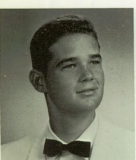
Photo: A younger Bruce Wayne Severy
My scholarly book also departs from “And So It Goes” in approach. I have taken years to find public documents and publications and lectures where I found Kurt Vonnegut’s words. His letters in books edited by Dan Wakefield and daughter Edie Vonnegut were important. Charles J. Shields conducted many memorable interviews. I respect his diligence even as I disagree with some of his conclusions in the biography. (He has declined to be interviewed for my book, and I respect his wish).
I conducted fewer interviews and concentrated on getting the facts right. I spoke in person only twice with Mr. Vonnegut. Based on those two conversations and years of research, I believe my scholarly biography will present a balanced portrait of Kurt Vonnegut. I still have work to do. Fans of Kurt Vonnegut still can help out by sending any letters, new material, corrections (including from “And So It Goes” or other Vonnegut books), or personal recollections to me at Hank Nuwer, PO Box 73446, Fairbanks, AK 99707. I still have interviews to do, and if readers have benefitted from my hazing work, etc., they are free to send donations with my thanks.