
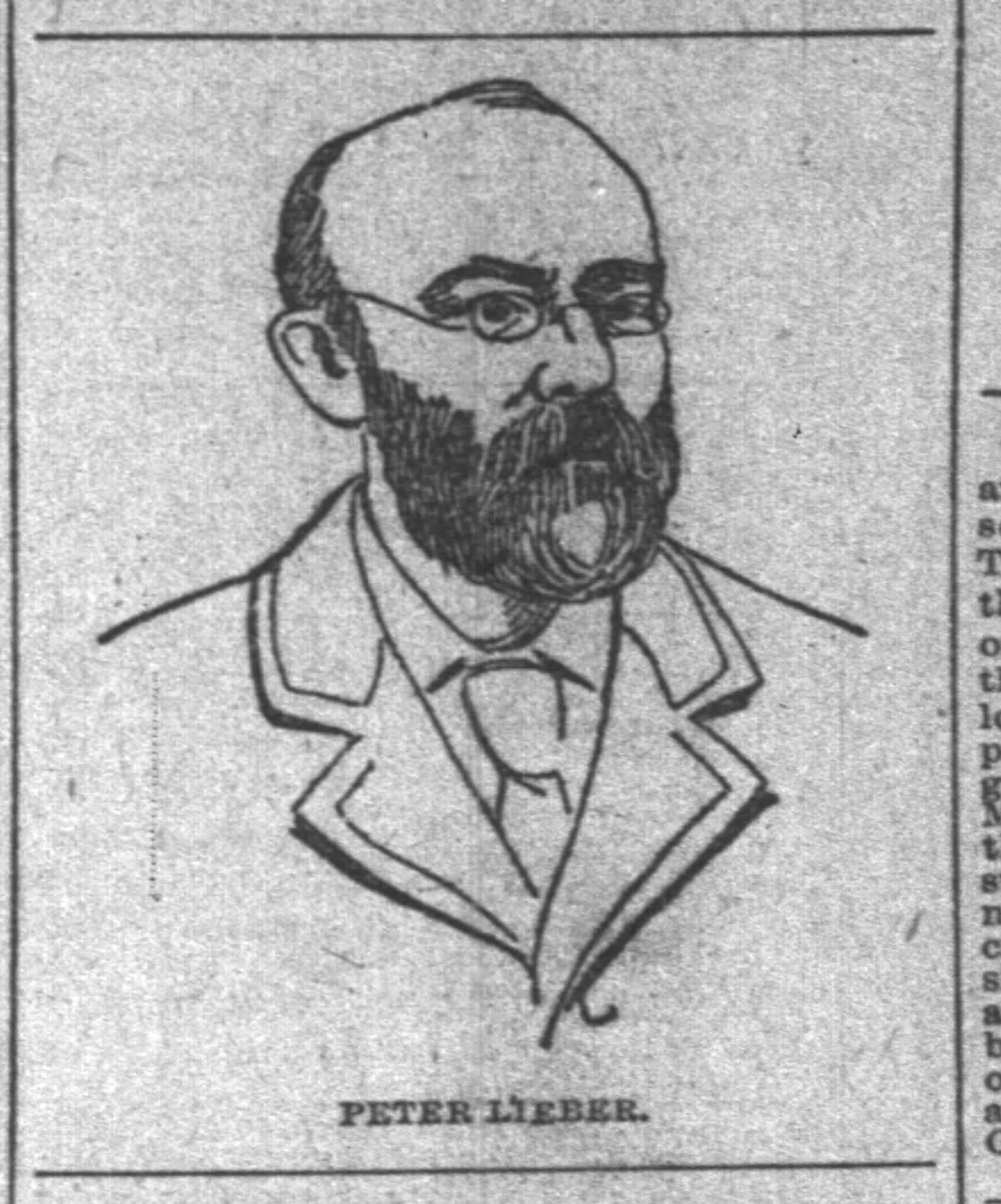
Excerpt is from “Appendix” in a work-in-progress, a biography of Kurt Vonnegut, by Hank Nuwer: Kurt Vonnegut: The Man in the Hole. A Life of Reinvention.
Link: A government official questioned the necessity of keeping Peter Lieber as Consul
The grandfather of Edith Lieber Vonnegut was the family patriarch Peter Lieber, born May 27, 1824, in Germany, one of five sons of Richard and Caroline Lieber. He was educated in the best schools of Dusseldorf and Aachen, Germany, the latter a few miles from a forest in the Ardennes where Adolph Hitler’s soldiers would capture, in 1944, young Kurt Vonnegut, Jr.
A political dissident, Peter set sail on a voyage to America in 1848. He never intended to stay forever in the United States. He was an immigrant who intended to one day go back to the Fatherland with his pantaloons loaded with treasure.
After disembarking, he lived first in Cincinnati, an adopted home with districts as German as any Auslander could wish. There, Peter Lieber applied himself to his duties as a factory laborer and perfected the skill of brush-making. Before too long, a rival plant in Hamilton, Ohio, recruited him and made him plant supervisor.
A worker bee with no serious sweetheart, Peter oversaw three hundred laborers. For a social life, joined the Cincinnati Social Turnverein. Turners prided themselves on demonstrating skill in gymnastics and showing off their bodily strength. Like other members, Peter was fit.
Herman Lieber, Peter’s brother and fellow dissident, embarked from Dusseldorf to the United States in 1848, living briefly in Cincinnati before moving to Indianapolis to open a book-binding shop. A newspaper warned that Herman possessed “revolutionary tendencies.”
Footnote: Indianapolis Star, November 28, 1929
Like many dissatisfied with politics in Germany, Peter was well educated, a university graduate, an artisan.
At first Herman’s business was stagnant. To while away the hours spent absent of customers, he framed prints to brighten his shop window. In no time, he discovered a flourishing enterprise. He abandoned the competitive book-binding trade..
Herman cajoled his brother Peter to leave Cincinnati and to join him in Indianapolis. Peter demurred.
Then, an ambitious friend named Charles Koehne filled Peter’s head with tales of a fortune to be made on the frontier west in Minnesota. Koehne now ran a country store and trading post in Brown County, Minnesota.
Germans were unpopular with some immigrant-baiting citizens of Cincinnati and Northern Kentucky. After a particularly nasty run-in with a police officer that made local headlines in the press, Peter Lieber and numerous members of the Turnverein pulled up stakes to join friends and relatives in the German settlement of New Ulm, Minnesota.
New Ulm was a Midwestern city bent on progress much like the fictional Gopher Prairie satirized a half-century later in the novels of 1930 Nobel Prize winner Sinclair Lewis. Named for a ninth-century German city on the Danube River, New Ulm was founded by a German entrepreneurial company in 1854, four years before Minnesota became a state. Many university-educated citizens departed as dissidents after the 1848 revolution. Non-Germanic settlers also swarmed the area. The Germans endured hostility from some settlers, while others admired their work ethic.
New Ulm displayed considerable prosperity upon Peter Lieber’s arrival. Sturdy brick buildings stood in the fledgling downtown, although on the outskirts of town, flimsy shacks of poorer citizens trembled during cold winds. A baker sold daily bread using readily available grain harvested from the surrounding golden prairie. A fellow named Adolph Seiter and his wife ran a hotel in town that never lacked guests. Children in traditional large families played games with string and toys carved from wood. A gigantic windmill as grand as anything in the Old Country impressed visitors.
At first, Peter struggled. He lost his savings in a St. Paul bank failure. He tried to rebound from his loss by partnering with Koehne to run the small store and trading post. Peter’s profits from furs and store merchandise enabled him to purchase land to farm. Koehne developed itchy feet. He sold his share of the store to Lieber and relocated over time to Ohio, Florida, and eventually Indianapolis.
A large population of Dakota, a Plains Indian tribe, lived a county away from Brown County but traded in New Ulm. The Dakota resented an indifferent federal government. Preoccupied with growing evidence that a civil war was imminent, the administrations of President James Buchanan and Abraham Lincoln failed to get treaty-guaranteed food and annuities to the tribe and their children. The Dakota grumbled that Lincoln ignored their needs with all his efforts on keeping the Union from crumbling. Tribal leaders who pleaded that they and their tribe were starving found their cries largely dismissed by government agents. Newspapers railed against indigenous people and vilified them as savages.
Significantly, an old man in his eighties one day would understand the pain of the displaced Native Americans. He would be wise enough to draw a connection between the angry, unemployed and underemployed Americans rendered useless by technology and the subsequent loss of jobs.
“There are no factories any more. Where are the jobs supposed to come from?” Kurt Vonnegut asked an overflow audience at Ohio State at a 2005 speech. “There’s nothing for people to do anymore. We need to ask the Seminoles: `what the hell did you do?” after the tribe’s traditional livelihood was taken away.”
In New Ulm, Peter enjoyed the friendship of fellow farmer Gustavus Andre (also known as Augustus or Gustavus de St. André) who was slightly older than he was. Gustavus at 28 was also nine years older than his bride Josephine, an immigrant from Germany. The two by 1860 reared a two-year-old son named Carl (Karl) and an infant named Bertha.
Gustavus discussed a scheme with his friend. He suggested that Peter consider marrying his 18-year-old kid sister if that was also her wish. Born August 16, 1839, she was yet unwed in Germany and agreed to move to New Ulm. Sophia André lived in Freiburg, the daughter of a mayor there who claimed ancestry from French royalty. One of the de St. Andres owned a castle, according to Vonnegut family legend, and Kurt dedicated his 1981 book Palm Sunday to his surviving cousins, along with a question: “Who has the castle now?”
After she arrived on the frontier by ship, train and coach, Sophia Andre experienced doubts about the arrangement. Peter was about seven years her senior.
Moreover, the long-haired, red-faced Peter Lieber resembled a mountain man with hands rough as corn cobs. She stood five-seven with blue eyes and a straight nose.
Despite her initial apprehension, Peter’s persuasion won her hand. Sophia married him on April 4, 1860. She bore Peter the first of five children, a daughter they named Caroline on June 7, 1861.
Footnote: Journey of German Argonauts to New Ulm, Indianapolis News, January 24 1906.
Shortly before Caroline’s birth, following the outbreak of Civil War on April 12, 1861, Peter decided to enlist with his brother-in-law in the 1st Minnesota Battery of Light Infantry on May 8, 1861. Kurt, writing in Palm Sunday, as well as biographer Charles Shields, incorrectly call Peter’s outfit the 22nd Minnesota Battery of Light Infantry).
Footnote: History of Brown County, Minnesota: Its People, Industries and Institutions, by. L.A. Fritsche, Indianapolis: B.F. Bower, 1915).
Soon after Sophia Lieber gave birth to Caroline on June 7, 1861, Peter heeded Herman Lieber’s entreaties to move his wife and daughter to Indianapolis where his brother now prospered selling mirrors, picture frames, lithographs and artwork. With Gustavus away serving the Union, Josephine and her two children accompanied Sophia Lieber to Indianapolis (with some time spent in Cincinnati with friends).
The Indianapolis News on October 24, 1906, with then-characteristic contempt for Native Americans, printed this explanation: “The Lieber family and some other, taking note of the ominous conduct of the savages, escaped [New Ulm] before the breaking of the storm.”
The decision to flee New Ulm may have saved Sophia, Josephine and their children a hideous death or defilement mere weeks later with no husbands to defend them. In August, 1862, the local Dakota Plains Indians grew fed up with the loss of their hunting grounds, the Union’s failure to deliver guaranteed annuity payments, and the corruption of federal Indian Affairs agents and traders.
Consequently, the Dakota unwisely sought retribution from settlers who likely were caught blindsided at the violent attack, according to Brown County historian Darla Gebhard. In two separate attacks, hundreds of Dakota killed more than 600 settlers and soldiers in New Ulm, Fort Ridgely, and surrounding towns. (The number of dead is an estimate at best since some of the missing never were accounted for). Atrocities abounded. Little Crow, a prominent chief who had traded furs with Peter, exhorted Dakota braves and squaws to kill any and all whites before he personally conducted a five-hour attack at Fort Ridgely on August 20, 1862.
On the farms in Brown County, ambushed men at their plows perished and many saw their homes torched. The bodies of family members and servants smoldered in the ruins. Many families lost three or more members. A great many died in hideous ways. Brothers, husbands and fathers lay dead on street and field. Dakota squaws brutally clubbed mother and infants.
Warriors mocked some husbands before killing them. A few witnessed the skirts of their wives or daughters pulled up by grunting Dakota males. Some terror-stricken cowards abandoned loved ones to a sad fate as they fled on foot or horseback.
The butchery to this day is a source of sorrow in Brown County. Dakota braves tore the fetus from the womb of at least one pregnant female. Braves nailed wailing infants to the doors of homes. Other warriors abducted women and children. Despite Dakota leaders’ promises of safety if the women and older girls would submit as wives or slaves, they clubbed some to death after submission. In short, the Dakota’s promises of safety proved as false and treacherous as the white government’s promises and treaties.
One man died after he raced inside into his house to retrieve his wife’s favorite dress at her request. Attacking Dakota burned the greater part of the city to get defenders out in the open. Townspeople and militia in turn torched some shabby buildings on the outskirts of New Ulm after Dakota shooters hunkered down there. Hundreds of immigrants, including some of the Germans who accompanied Peter Lieber to New Ulm from Ohio, abandoned the area and their homes and dreams.
A number of Dakota died in the fighting, burned to death in torched houses, or gunned down in a hail of hot lead as they charged armed inhabitants holed up in the town’s stout brick buildings.
In the end, the uprising failed to stop Minnesota’s settlement, and it again prospered. Authorities sentenced 307 captured Dakota to death by lynching. Perhaps fearful of reprisals by the Dakota and other tribes, Lincoln reduced the number of doomed men to 38 natives.
A settler named William Duley whose family perished became the appointed hangman. The condemned stood on a make-shift gallows. One brave defiantly grabbed his crotch in scornful defiance, according to a local newspaper.
Four thousand spectators came from near and far to watch the grisly spectacle. On command, Duley slashed a single rope. The braves twisted and spun like tops. Authorities dispatched a couple braves after their nooses failed to hold.
A few Dakota leaders who escaped immediate arrest later were shot to death for bounties of up to $500. Injured by cannon shrapnel, Little Crow fled to Canada and was killed upon his return to the United States in 1863, according to historian Darla Gebhard of the Brown County (Minnesota) Historical Society.
Gustav or his wife Josephine (nee Josefina) applied for a government reimbursement claim on their property with the 1863 Dakota Claims Commission. Peter Lieber’s name was not on the list of those filing.
(#)
Gustavus and Peter engaged the Confederacy at the bloody battle of Shiloh which occurred at Pittsburgh Landing, and then marched south to Mississippi to participate in the first siege of Corinth. Kurt Vonnegut saw the irony in his relatives abandoning warlike Germany and then enlisting. “The Germans came over here because they were against militarism, and a lot of them arrived just in time to serve in the United Army,” he told Susan Neville of Arts Indiana. [p, 46]
In June of 1862, Peter’s knee was torn up, likely in battle at Corinth. His affected knee required a hospital stay of more than one month at Barracks Hospital in St. Louis that summer of 1862. Doctors informed him that his days of service were over.
Gustav fought on for the Union with his Minnesota division, only to die from illness at Vining Station (then also called Vining’s Station), Georgia on September 4, 1864. The exact cause of death was unknown, but a common threat to life was dysentery caused by men drinking contaminated river water containing the dead bodies of horses and soldiers.
My scholarly book also departs from “And So It Goes” in approach. I have taken years to find public documents and publications and lectures where I found Kurt Vonnegut’s words. His letters in books edited by Dan Wakefield and daughter Edie Vonnegut were important. Charles J. Shields conducted many memorable interviews. I respect his diligence even as I disagree with some of his conclusions in the biography. (He has declined to be interviewed for my book, and I respect his wish).
I conducted fewer interviews and concentrated on getting the facts right. I spoke in person only twice with Mr. Vonnegut. Based on those two conversations and years of research, I believe my scholarly biography will present a balanced portrait of Kurt Vonnegut. I still have work to do. Fans of Kurt Vonnegut still can help out by sending any letters, new material, corrections (including from “And So It Goes” or other Vonnegut books), or personal recollections to me at Hank Nuwer, PO Box 73446, Fairbanks, AK 99707. I still have interviews to do, and if readers have benefitted from my hazing work, etc., they are free to send donations with my thanks.