
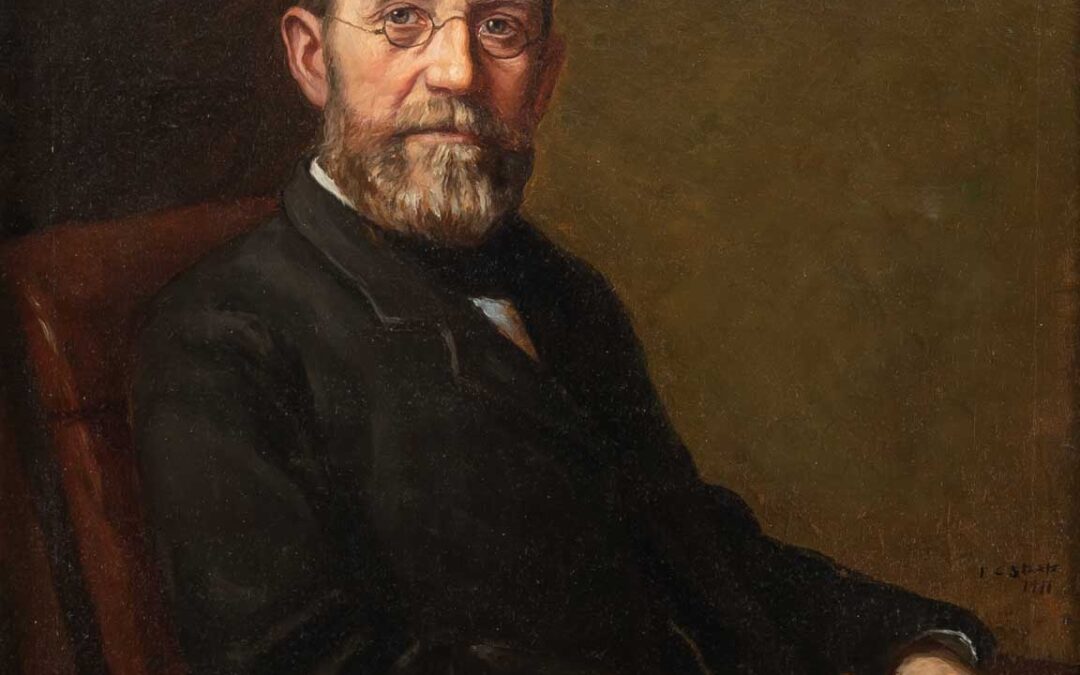
Excerpt from a work-in-progress, Kurt Vonnegut: The Man in the Hole. A Life of Reinvention. by Hank Nuwer
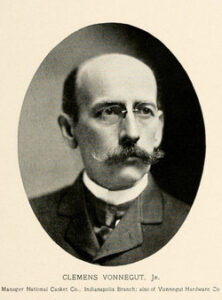
Kurt Vonnegut, Jr. said in Palm Sunday that his relative was a “cultivated eccentric” as the family historian John Rauch, Sr., had once described the hardware scion. “That’s what I aspire to be,” Kurt wrote. Palm Sunday (Page 28) by Kurt Vonnegut says that Clemens’ life ended with him “lying by the side of the road—quite dead.”
As you will read, that’s not exactly right, not at all. (PS: Biographer Charles J. Shields omitted any mention of Clemens’ death in a mere four-page section on Clemens cobbled together in an appendix in “And So It Goes: Kurt Vonnegut: A Life.”).
Chapter: Death of a Salesman
Kurt Jr.’s fatal fall in 2007 echoed the death of the Vonnegut patriarch Clemens Vonnegut, Sr., the silk salesman whose genius for merchandising and promotion created a successful hardware business, met his end.
Frail, weighing under 100 pounds, the 82-year-old widower left the North Delaware street home of 73-year-old Caspar Blank, his wife, and son-in-law following an afternoon visit on December 7, 1906. Clemens mentioned that his next stop was about one mile away at a planned dinner on tree-lined 618 East Thirteenth Street with son Bernard. Noting that his in-law was a bit shaky and flimsy-kneed these days, Blank suggested alternate transportation.
“Are you sure a man your age should be out so late?” he asked.
Clemens pooh-poohed his relative’s fear and stepped out in the cold in his heavy coat with hood.
The old man failed to show up for the supper with Bernard. Without delay, Bernard alerted police by phone and organized a search party.
Four officers and eight detectives set out on foot and by bicycle to search every side bush, alley and backyard outhouse for the octogenarian. The Indianapolis Star posted a citizen alert on December 8. That same day, a construction worker spied the unconscious Clemens sprawled against a rail fence far away at the site of the future Indianapolis Speedway. Tired and confused, Clemens unfortunately took a streetcar that would take him many miles away from Bernard’s residence. The rescuer placed him in his horse-drawn buggy and rifled through the old man’s pockets. He found identification papers that helped him attach a name to the bearded, wrinkled face. Then he rushed him off to get medical assistance.
At Deaconess Hospital, physicians Guido Bell and H. O. Pantzer diagnosed pneumonia caused by overnight exposure. They were unable to understand what the delirious Clemens tried to tell them in German. They set his broken shoulder, and he passed out from pain and exhaustion.
When Clemens, Sr. awoke, he found Bernard at his bedside. Bernard’s forehead was winkled with worry.
The old man asked to see his grandson Alex.
Bernard reminded his father that Alex was back East at Harvard.
“This injury will probably make a change in Alex’s Christmas plans,” Bernard said. “He will perhaps come home earlier.”
Now it was the old man’s turn to show concern and confusion. “Why, is Alex hurt?”
Dr. Pantzer stopped by for another bed check. He asked the old merchant how he came to be in such a fix. The simple question brought a direct answer.
“I slipped on the ice.”
The ordeal was too much for the frail old merchant.
Clemens Vonnegut, Sr., the hardware king of Indianapolis, died from pneumonia on December 13, 1906, at 7 a.m. His will divided the estate equally among his four son, one of which, Kurt’s grandfather Bernard, was to follow Clemens in death very shortly. The old man over the years had given family members ample gifts, and now his personal property was worth a modest $25,000.
Five years later, at a ceremony attended by architect Kurt Vonnegut and other family members, Public School No. 9 was renamed in honor of Clemens Vonnegut, Sr., and all he had done to boost education in Indianapolis. During the ceremony, one of the deceased’s last sentiments was read aloud. He had said this: “Friends, departing from life with love for all mankind, I would urge you to be mindful of this truth: All men could be happy if they would live sensibly and would endeavor to contribute to each other’s happiness.”
Footnote “School Named for Vonnegut,” The Indianapolis Star, April 13, 1911]
Hello, Readers. I am going to publish teaser sections from my in-progress biography of Kurt Vonnegut in hopes of raising funds to do more interviews in person. If you can help: send to Hank Nuwer, PO Box 73446; Fairbanks, AK 99707. Thank you. HN