
Related article: Relatives of Kurt Vonnegut enrolled as members in Nazi Party
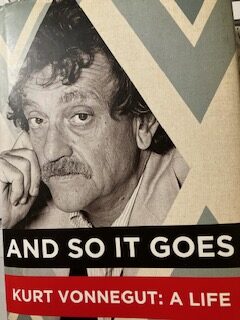
Charles J. Shields, And So It Goes: Kurt Vonnegut: A Life. Henry Holt and Company, (hardcover with introduction; paperback with introduction excised by publisher without explanation).
Fifteen years following the release of “And So It Goes: Kurt Vonnegut: A Life,” I decided to reassess the biography by Charles J. Shields, aka Chip Shields. Having visited Shields’ Vonnegut Collection at the Indiana Historical Society in 2025, I felt especially compelled to point out the factual errors and questionable interpretations that might shame any first-rate biographer.
At the very least, a reader might expect a biographer to respect the works of his biography subject.
Not so. The Indiana Historical Society has a letter from Shields (after Vonnegut’s death) to author John Updike. Shields confessed he was no fan of Kurt Vonnegut’s books. He told Updike he wanted to throw two of his subject’s novels across the room.
I credit Shields for locating prime sources for interviews, but his diligence isn’t evident while contemplating Vonnegut titles such as Mother Night, Galapagos, and Deadeye Dick. “Chip” Shields admitted in an online interview that he read each Vonnegut book only once. Would Kurt Vonnegut himself given permission for a biography if he knew how little preparation this biographer was prepared to offer?
Unforgivable errors jump like fleas off the pages of And So It Goes. One wonders how the biography’s embarrassing mistakes slipped past former Henry Holt and Co., editor Helen Atsma (now with ECCO) and Folio Literary Management agent Jeff Kleinman.
For the life of me, I cannot see why Washington Post reviewer Bill Sheehan judged “And So It Goes” an “excellent biography,” The writing (syntax) is problematic, as several reviewers pointed out.
It’s not too late to run a correction, Washington Post. (Kidding, of course. Reviewers do not expect to proofread or factcheck. There is an assumption that the biographer and his/her editors have performed due diligence and gotten all facts correct).
The biography falls short of what I hoped to read from Shields, the co-founder of Biographers International Organization, and author of biographies of John Williams, Lorraine Hansberry and Harper Lee.
Shields acknowledges in several print and taped interviews that he promised Kurt Vonnegut he would share negative information that came out in his interviews with various sources. This concession came about because Vonnegut informed Shields that wife Jill Krementz gave him grief for consenting to cooperating with this biographer.
In my opinion, any biographer giving that kind of permission is writing a hagiography, or worse, ersatz biography, not literary biography.
That promise to spill the bad beans no longer held after Vonnegut died from a head injury incurred in a mishap hours after welcoming Shields into his New York townhouse.
And what Kurt didn’t know would, after his death, hurt him and his reputation.
“I don’t mean to sound ghoulish, but isn’t that the ideal situation for a biographer, to have your subject cooperate happily with you, and then die, leaving you a free hand,” Shields told an interviewer.
Macmillan (publisher) can start making amends for this flawed bio by correcting the number of pages it claims is in the paperback.The publisher scrapped the hardcover intro with a sort-of Norman Mailer-like advertisement for the biographer and how he coddled Vonnegut into allowing him to be his biographer.
The 544 pages listed by Macmillan in its web site promo for Shields are now a mere 515 pages.
I believe consequences happened because of that omission. Shields forgot to delete references in his index that refer to the dropped introduction. Hence, a reference to John Updike cites a blank page, for example. Two references in the index to Jill Krementz take the reader to the Contents page.
In addition, I think Shields’ index should have listed “Jill” Krementz by her legal name: Virginia Hyde “Jill” Krementz. Thoroughness is a courtesy a reader expects in an index. Some names referred to in the biography cannot be found in the index. That’s a crucial omission for me. This bio is for the historical record, after all.
Accuracy in a biography is more than a virtue. It’s a commitment to the readers to ask them to trust said biography is a true biography, not a Day of Judgment. I think the decision to drop the intro was an unfortunate choice btw. Yeah, it’s bloviated and tedious with self-praise. But the publisher ought to have insisted it remain in the paperback.
Here follows a list of items from “And So It Goes” in need of correcting.
Biographer Charles J. Shields misidentifies Vonnegut’s Indianapolis birthplace address. Yes, even though 955 N. Pennsylvania St. is on Vonnegut’s birth certificate.
Also, Shields lists the Vonnegut longtime home as 4401 N. Illinois St. The correct address of the boyhood house is 4365 N. Illinois St. The address number changed to “4401” around 1940. 1940? Yeah, when Kurt Vonnegut attended college at Cornell University.
Shields said the architect who designed the N. Illinois home was William Osler.
No, it was Indianapolis architect Willard Osler. William Osler was”The Father of Internal Medicine.”
“I don’t get edited—barely at all,” Shields boasted to an interviewer. I’m afraid absurdities like substituting “William Osler” for “Willard Osler” reflect that lack of editing.
Vonnegut household servant Carrie B. Hatterbaugh is misspelled “Cannie Hatterbaugh,” Charles McKinley Nice and his wife Clare should have been spelled Charles McKinney Nice and Sadie Claire Mapes Nice (Bingham).
He also misspells “Southampton” on Long Island, a second home for Vonnegut and wife Jill Krementz.
Vonnegut’s wife Jill refused to give him an interview. Boy, did Shields make her pay. Reviewer Laura Wells wrote that Shields made Jill out to be a harridan. Or worse. Her unrequited love affair takes up too much room in the Vonnegut bio, as do Kurt’s own love affairs.
Here’s Shields’ scoop. Jill fell in love with a retired hotshot and was cheating on Kurt in trysts at her studio. Simultaniously, the lover was also cheating on Jill with a painting artist.
Oh, yes, it’s all so Truman Capote-yyyyy gossipy, isn’t it? The footnotes show that Knox Burger, a friend and Vonnegut confidante, served as a teller of many tales. Plus Burger turned over a stack of correspondence to Shields.
Back to the barrage of errors.
In Chapter One, Shields writes about young Kurt’s relationship with African-American cook Ida Young.
Shields portrayed Ida Young as a “widow.” when she worked for Edith and Kurt Vonnegut. Ida Young didn’t become a widow until Owen Young, at 57, died on February 3, 1935, long after she left the Vonnegut family.
Shields writes that Vonnegut enlisted in the U.S. Army in March of 1943. Vonnegut’s service record notes his enlistment as April 6, 1943.
Then, Shields wrote that Kurt married first wife Jane Cox on Sept. 14, 1945. Uh-uh. The wedding took place Sept. 1, 1945.
Shields claimed Vonnegut’s parents attended the wedding of Irma Vonnegut (sister of Kurt Sr.) in Germany in 1924, leaving young Kurt with relatives.
Nope. Irma Vonnegut married Kurt Lindener on August 18, 1922. The pregnant Edith Vonnegut and Kurt Sr. didn’t attend the wedding. Young Kurt was not yet born, posing an obstacle to his parents leaving him with relatives.
The Vonnegut parents did sail to Europe in 1924 to visit the Lindeners and their son Arthur. THAT is when Kurt stayed with relatives, likely Uncle Alex, brother of Kurt Sr.
Also, Lindener’s wealth came from ownership of vast Guatemala coffee and sugar plantations. Shields incorrectly placed the plantations in Honduras.
And Shields apparently never checked archives to look up Lindener’s past. Vonnegut’s Uncle Kurt Lindener not only joined the Nazi Party, but he lined his pockets as a petty bureaucrat in two Polish cities with notorious ghettos. And Aunt Irma Lindener at least considered divorcing Lindener in 1950.
Then there’s a “grave error” by Shields of enormous significance. In the climax of Vonnegut’s classic “Slaughterhouse-Five,” an older American foot soldier is put on trial and shot by a German firing squad for swiping a teapot from a ruined building in bombed-out Dresden.
Vonnegut took creative license here.
The unlucky POW is a composite character mainly drawn from POW Michael Palaia who swiped a jar of string-beans. Taking plunder meant death upon conviction.
Shields writes that Palaia “was one of the older prisoners and unable to withstand the deprivations as well as the younger men.”
No, the prisoner was neither older nor feeble, Here, biography became fiction. PFC Michael D. Palaia in reality was a sturdy, strapping 6’2 youth of 19.
Shields fails to factcheck the date Palaia died. Vonnegut and a few other POWS with him in Dresden wrongly claimed the execution occurred on Palm Sunday, 1945.
Shields writes that a firing squad executed Palaia and a Polish soldier April 1, 1945, Palm Sunday.
An online calendar lists April 1 as Easter Sunday. Palm Sunday was March 25, 1945.
German records note the actual execution as Saturday, March 31, 1945.
Here’s the grave error, far more consequential. Shields writes that Vonnegut was one of four men in the vicinity of the execution who were made to dig a grave and bury Palaia.
No, Vonnegut was not near the execution and learned of it second hand. Nor did he wield a pick and shovel.
The actual grave diggers were Harry E. J. Kingston, Henry Edward Hall, Joseph Topicz and Floyd T. McLea. The truth was scattered in interviews and commentary by Dresden POWs in the 2008 book “Shadows of Slaughterhouse Five” by Ervin E Szpek, Jr. and Frank J. Idzikowski.
Shields names this book in his list of works cited.
In “Shadows of Slaughterhouse Five,” we learn the real names of the grave diggers from the post-war interviews of military war crime investigators Joseph Carpenter, William Busch and Joseph S. Smith.
The interviewers learned the second executed prisoner was a Russian, not a Pole as Shields writes.
It is likely Shields regrets not pressing Vonnegut about the Palaia matter during two interviews at Vonnegut’s New York home.
Vonnegut upon his arrival home in Indiana from captivity as a Nazi slave in 1945 told his Uncle Alex Vonnegut about Palaia’s demise. It is possible that Kurt claimed to be a grave digger, but it’s also possible notoriously ditzy Uncle Alex wrongly assumed his nephew was present for the execution.
Shields, to me, seemed more patient and tolerant of character flaws in another biography subject of his, John Williams, in The Man Who Wrote the Perfect Novel. Williams, it seems, embellished his World War Two exploits. “Call it lying,” says Shields with regard to John Williams, “but writers call it creating fiction.”
Next up, Shields quotes Vonnegut’s wartime pal Bernard O’Hare describing their capture during the Battle of the Bulge and crying “Don’t s_ _ _” instead of “Don’t shoot!”
Vonnegut in his nonfiction said he assured O’Hare’s widow the story was untrue nonsense. That anyone saying anything like that at the point of capture might get shot, not guffaws.
Some other errors by Shields can be traced back to errors by Kurt Vonnegut in his autobiographical writings.
Shields repeats a misspelling by Vonnegut’s Uncle John Rauch of the last name of Charles Volmer, an Indianapolis merchant who persuaded boyhood friend Clemens Vonnegut Sr., Kurt’s great grandfather, to settle in Indianapolis and open a shop with him. Shields wrote about “Volmer” as “Vollmer,” ignoring several city directories. See inserted photo below.

Then there’s Kurt’s maternal grandmother, Alice Barus Lieber, who died of illness at 30 on Dec. 10, 1897.
Vonnegut thought she died during childbirth with Vonnegut’s Uncle Rudolph Vonnegut. Nope, Uncle Rudy was born Jan. 5, 1896.
Instead of pointing out Vonnegut’s error, Shields writes incorrectly that Rudy was five when Alice died. Do the math.
Kurt Vonnegut Sr. died Sept. 30, 1956, of lung cancer after a lifetime of smoking. Shields claims ”no one came to check on him regularly” except a nurse. But sister Irma Lindener flew from Germany to Indianapolis in late July ’56 to comfort him.
We find several errors by Shields in Chapter Six. Kurt’s
sister Alice lay dying of cancer in a hospital, her husband James Adams dies when his commuter train sailed through an open bridge into Newark Bay.
Shields writes that the train engineer died of a heart attack while the fireman alongside him wasn’t able to halt the train.
No, a pathologist ruled out a heart attack, and experts could not say with certainty if the engineer was incapacitated at the fatal final moments.
Moreover, the fireman left his post, leaving the engineer alone. This was a huge absence since the fireman might have stopped the train from hurtling into space. It was quite the mystery and covered in newspapers, magazines, everywhere,
Everywhere except in “And So It Goes.”
After the deaths of Vonnegut’s sister and brother-in-law, Kurt and wife Jane took in their sons James Jr, Steven and Kurt. Shields introduces an older sister of the late James Adams. She helped with bills.
The aunt is Louise Adams Donner, or Mrs. Carl Donner.
Shields changes her name to the pseudonymous “Donna Lewis.” Carl Herman Donner becomes “Carl Lewis.”
Two footnotes cite an interview with “Donna Lewis” on July 27, 2008. Neither footnote explains why the biographer obscures her identity.
I consulted the Charles J. Shields papers at the Indianapolis Historical Society to examine this interview.
Shields discloses that he goofed and neglected to tape her side of the phone interview. Instead of conducting a second interview, Shields relied on his memory.
Shields’ blistering biography certainly changed the world’s impression of Kurt Vonnegut.
“So It Goes” portrays Vonnegut as a skirt-chasing, grouchy, adulterous wreck of a man and something less than a genius as an author.
Here is another big fault in the biography. Shields pads the biography with paragraph after paragraph of literary criticism. Shields, hoever, woefully lacks the true critic’s talents.
Shields had venom to spare. Thus, he spares no one. He refers to Kurt’s patient, elderly agents as “gasbags,” although they protected Vonnegut when magazine stories came back to them with rejection slips.
Shields credits Knox Burger, an early editor of Vonnegut, for giving him a treasure trove of Vonnegut correspondence and a tub of dirt to use.
Shields appears to speak for Burger: some revenge from the grave served cold for Kurt Vonnegut reneging on a promise to dump longtime agent Max Wilkinson and to sign with the new agency created by Knox Burger and his wife Kitty.
When Vonnegut reneges on a promise to Burger to dump his old agents and sign with Burger, Shields paints Vonnegut as a false friend.
Burger was a good editor but never shy about giving his brusque two cents after reading Vonnegut manuscripts.
Shields dedicated the hardcover to his benefactor, along with a pun, “Hang a Gold Medal on him.”
Shields deleted the obsequious dedication to Knox Burger in the paperback version of “And So It Goes.” Perhaps the biographer, his editor, or both saw at last the ethical conflict of dedicating a book to a primary, hardly impartial source. Shields then changed the dedication in his paperback edition to his wife Guadalupe.
Shields saves his blows for second Vonnegut wife Jill Krementz, an accomplished photographer. The biographer savages her as bitchy, neurotic and unlikable. The marriage wasn’t made in heaven, that’s true, but in the end Kurt and Jill remained hitched. They might have been like the survivors after a head-on crash, but they did survive.
What’s more important to me than her failed late-in-life fling is her body of work as, in my view, the best of the best (or among the best at least) in photographing authors in their habitats.
It was instructive for me to read transcripts of the biographer’s interviews with sources and see how he steered the conversation.
Always he allowed how he was trying to be fair with Jill but found few who liked her.
A judge would have tossed him out of a courtroom for leading the witnesses, but it worked. Each source babbled some new harsh tidbit that allowed Shields to cast Krementz as a harpy from hell.
When Jill declined to go on the record, Shields wrote her a letter, to me rude and unseemly, where he advised her to talk with him because so many of his sources framed her in negative terms.
Moreover, that prissy and intolerant side of Charles J. Shields jumps off the page now and then in “So It Goes.”
And when Kurt and Jill attend a huge feast at a party for Craig Claiborne attended by 36 chefs and a boatload of celebrities, Shields knocks himself out with irate indignation: “a good example of the disconnect between the values (Vonnegut) espoused and the life he was living.”
The hardcover edition of the biography contained a self-indulgent introduction.
In the hardcover intro, Shields said he convinced Kurt to let him be his authorized biographer by praising Kurt’s books as “part of the literature that guides and inspired the next forward-looking age.”
Shields exults that he worked an “OK” out of Vonnegut.
Someone else might “cobble together” a Vonnegut bio, Shields warned Vonnegut. Shields must have skipped telling Vonnegut the part about wanting to throw two of his books across the room.
And at times the biography by Shields clearly reads “cobbled together!”
The final chapter is titled “Waiting to Die.” The title suggests that it’s about a final year or two in Vonnegut’s life, but not so. It runs a mere 29 pages and covers the author’s last 15 years, That’s right, under two pages for each remaining year, 1992-2007, giving the impression that Shields had deserted, not completed the biography. There’s also an annoying anonymous source paraphrasing Vonnegut in Footnote #56 in that chapter.
Moreover, the appendix provided as an afterthought by Shields about Vonnegut’s ancestors reads to me like cobbled, undisciplined gibberish. Much was taken piecemeal from Vonnegut’s Palm Sunday, Uncle John Rauch’s flawed family history and a bunch of old news clips.
So it blows.
The bulk of Vonnegut’s quotations and paraphrased words given to Shields came the last two days in the long life of a tired-out, diminished Vonnegut. There were phone calls, in addition, and some correspondence, Shields assures readers.
Shields describes the author as unhealthy in appearance during their chats at the Vonnegut New York townhouse. Indeed, Vonnegut’s last comments attributed to him by Shields make the witty Vonnegut sound morose and whiny.
For a more positive view of Vonnegut, you can read Dan Wakefield’s Kurt Vonnegut: The Making of a Writer; it does get hard to read from the unusual point of view. And Wakefield also incorrectly places Vonnegut at the site of a prisoner’s execution.
Ginger Strand’s The Brothers Vonnegut, Loree Rackstraw’s Love As Always, Kurt Vonnegut as I Knew Him (biblically). Strand also has two glaring mistakes I found, but these are far, far fewer than you’ll find in And So It Goes. Strand has a compelling way of mixing facts with anecdotes. In other words, her storytelling skills are pronounced.
Shields left the brownstone after the session with Shields on March 14, 2007. That evening Vonnegut fell while outside and was never to revive. Shields noted that fall in his notes. His first reference to the fall in his notes says nothing about Kurt tripping over a leash.
It was only much later, in his biography, Shields dresses up the story by saying Vonnegut tripped over his white dog Flour’s leash. He sets this up with a bon mot where Vonnegut expressed his premonition he would be killed by a dog.
That Flour tripped his master may or may not be a shaggy dog story. The Kurt Vonnegut who appeared in a final appearance on Jon Stewart’s TV show clearly shuffled over to his chair–his balance definitely off kilter. (Bless you, Jon Stewart, for giving us this last bit of Vonnegut sauciness). Vonnegut pointedly disses Donald Rumsfeld and Stewart says this: “I’m very sorry to see you’ve lost your edge.”
The 911 caller who saw Vonnegut on the pavement with a grave head injury gave neither his name nor much detail to a dispatcher. The biographer’s sources for the “leash” story is a “summary of interviews with Lily Vonnegut, Edie Vonnegut, and Knox Burger.”
None of the three named sources saw Vonnegut fall. And Flour became the fall guy, er, dog.
The biography ends with the author’s death April 11, 2007. Shields therefore heard Vonnegut’s next-to-last infamous words.
“Do you believe in God?” Shields asked Vonnegut.
“I don’t know, but who couldn’t?” Vonnegut replied.
Vonnegut scooted around the direct question. What a pity Vonnegut didn’t scoot around other questions. Sadly, Vonnegut’s last days saw him grow morose and cynical with age and infirmities.
Shields was an indefatigable researcher. His interviews with dozens of sources stored at the Indianapolis Historical Society will be used in dozens of scholarly articles and, undoubtedly, future Vonnegut biographies. Disclosure: Including my own in-progress scholarly biography of Kurt Vonnegut.
I sent an email to Charles J. Shields to ask him for an interview. He declined. Yes, I had a million questions. Questions that should have been asked during softball sessions by NPR and other interviewers.
In particular, I wanted to ask the biographer about Mark Vonnegut’s charge that “So It Goes” was “a book whose existence is completely and utterly dependent on a picture that Shields would have made up out of whole cloth if he had to.”
Perhaps “So It Goes” could be worse, could contain more factual errors and self-righteous pronouncements. But, for the life of me, I don’t see how.
Books routinely were sent to reviewers years ago with an appended sheet of author or editor corrections.
I would hope the publisher would ask the author to help readers and, yes, Vonnegut scholars by removing these mistakes in future printings and replacing them with carefully checked factual information. The biographer put too much work into this book to let misinformation mar the work as it now does.
Also, Macmillan oughta drop the hyperbole in its “And So It Goes” press release: “The extremely wide and overwhelmingly positive review coverage for And So It Goes has been nothing less than extraordinary and confirm it as the definitive biography of Kurt Vonnegut.”
In conclusion, I should mention that Charles J. Shields did. get one factual thing right.
There does seem to be a state named Indiana where Kurt Vonnegut was born.
Hank Nuwer, University of Alaska adjunct professor and Cordova Times columnist. This post appeared in different lengths in the Cordova Times and the State House File. His interviews with authors Vonnegut, Harry Crews, James Dickey, David Mamet and so on can be found in biographies and collections of interviews. Here is a link to his conversation with Kurt Vonnegut.
Updated April 19, April 20 and July 19, 2026.