
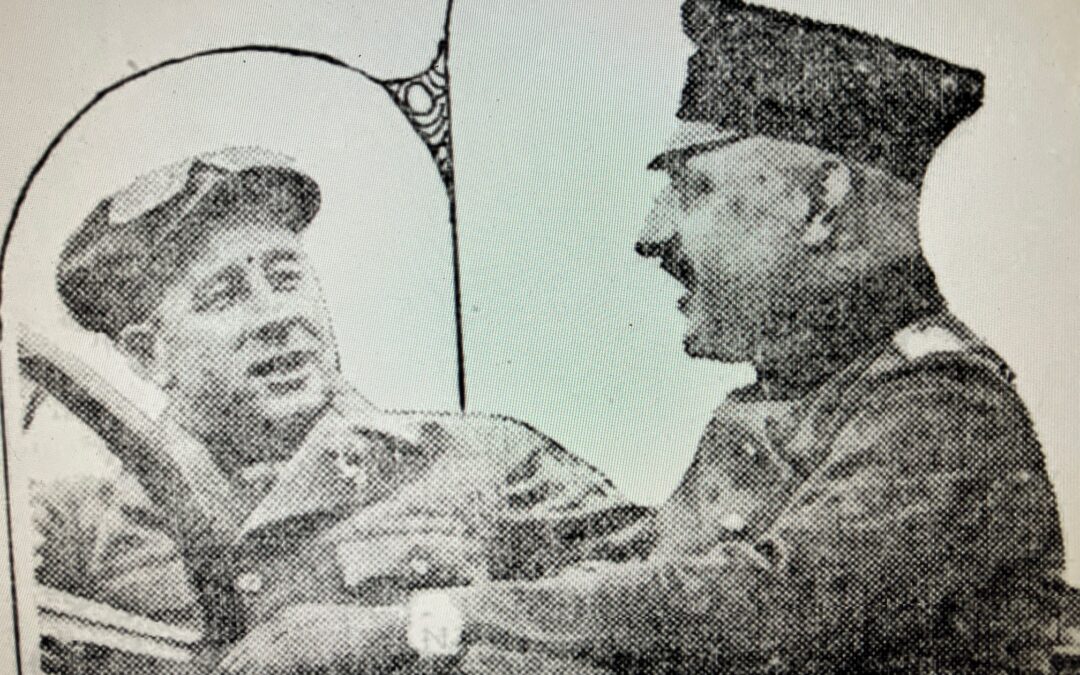
Publicity photo of Wilbur H. Durborough and Captain Erwin Herber
By Hank Nuwer, written for my Cordova Times (news outlet of Alaska) column: July 16, 2026. That bio chapter was edited for space. The full, updated, and complete version is below. Thank you. HN. Please cite the Cordova Times and Information taken from “Kurt Vonnegut: The Man in the Hole. A Life of Reinvention,” an in-progress biography of Kurt Vonnegut, Jr. by Hank Nuwer
Addendum: Aug. 3, 2026
In the autobiographical beginning section of Slaughterhouse-Five, Vonnegut tells us he is “a fourth generation German-American.”
German soldiers captured Army scout Kurt Vonnegut, Jr. in December of 1945 during the Battle of the Bulge. His captors, taking note of his last name on his dog tags, asked why he made enemies out of his German brothers.
His captors were unaware that Edith’s brother Rudolph had served in the German army during the Great war as a lieutenant along with Captain Erwin Herber, the husband of the late consul Peter Lieber’s green-eyed, brown-haired daughter Emma who had been born in Indianapolis.
Kurt, however, likely in turn was unaware that Rudolph and Erwin long before had joined the Nazi Party, as had Irma Lieber Vonnegut’s husband Kurt Lieber. He did assume his cousin, Kurt and Irma’s son, was now a German soldier, but would only learn after the war that Arthur Lindener not only had been captured by the Russians, but that he would live long enough to be released from one of the notorious Soviet camps where many former German soldiers perished.
Searchable Nazi Party membership records from the U.S. National Archives reveal that by the time Kurt was a teenager, at least three of his relatives, by marriage or blood, had enrolled in the Nazi Party by 1933.
The records do not specify why they joined the Nazi Party or the extent of their involvement, and I do not presume to judge their motives. Their reasons died with them. Nor does this news in anyway taint the legend of Kurt Vonnegut. Many American families of German descent had relatives across the sea who joined the Nazi Party.
The records, examined with a DIE ZEIT search tool, also identify more than a dozen other Nazi Party members living in Germany with the Vonnegut surname.
No evidence exists that Kurt Vonnegut, Jr. fully explored his relatives’ Nazi Party involvement. Biographers can only speculate whether his mother, Edith Lieber Vonnegut, knew of these memberships prior to her death in 1944, months before her son was taken prisoner.
Vonnegut later made several ironic comments noting his parents’ reluctance to train him in German customs and language. He apparently never considered his German captors to be his brothers.
Vonnegut survived the firestorm at Dresden, Valentine’s Day 1945, famously referring to it as a massacre.
My first database hit identified Rudolph (Rudolf) Lieber. He hailed from Dusseldorf. He was the brother of Albert Lieber, Edith’s father and Kurt’s maternal grandfather. Edith and Albert Lieber met him many times on their visits to family in Germany. He, in turn, visited Indianapolis on occasion to meet with his Lieber kin, according to multiple newspaper accounts.
Rudolph was born February 7, 1874. He and Albert were two of the sons of German immigrants Peter and Sophia Andre Lieber. Passenger records listed him as five foot, ten inches tall, with dark hair, a fair complexion, and blue eyes.
The database confirmed Rudolph Lieber joined the Nazi Party on April 1, 1933. His birthplace was recorded as Indianapolis. His residence was recorded as Dusseldorf. His Nazi Party entry number was 1.779.255.
Family patriarch Peter Lieber, a brewery owner, amassed a personal fortune in America, but his heart was always with his German homeland. He and his wife Sophia Lieber departed Indianapolis in the late 1880s, and Peter put his businesses in son Albert’s hands.
Rudolph Lieber departed America as a teen in 1888 and studied in Germany. He enlisted in 1894 in the service of German Emperor William II. His wife’s name was Minna Lieber, and they had a son named Hans Adolf Lieber (Born July 28, 1900; his name does not appear as a Party member).
A captain at the start of World War One, prior to America’s involvement, Rudolph Lieber “engaged in drilling a regiment of Uhlans” for service on the front in Russia or France, according to the Indianapolis Star of November 15, 1914. 
Following the war, on April 30, 1928, Rudolph Lieber, then 54, and his unmarried sister Laura Lieber, sailed to America on the Dresden and visited Mrs. Kurt Vonnegut and other family in Indianapolis. Young Kurt would have only been five years old then.
A second Nazi Party relative by marriage of Kurt Vonnegut, Jr., was Erwin Herber, christened as Adolf Maria Erwin Herber. Erwin was born in Dusseldorf on October 25, 1874. The database confirmed Erwin joined the Nazi Party in Dusseldorf on April 1, 1933. It listed him as member number 1.779.249.
Erwin Herber was the husband of Edith’s Aunt Emma Lieber Herber, the sister of Rudolph and Albert Lieber.
Erwin Herber fought in combat for Germany in World War One. On August 5 and 6, 1914, headlines in blazing black fonts announced the attack on neutral Belgium by the orchestrated German army against a stalwart Belgian defense.
France dispatched reinforcements to the bloody Liege battleground to aid the Belgians after Germany destroyed two military forts in Belgium. Herber was in the advance military units stationed at the front in Liege.
Of 300 soldiers that had commenced firing in the battle waged on August 5, only Herber and 14 of his men survived, reported the Indianapolis Star on November 15, 1914.
“Captain Herber, terribly wounded, lay in a trench half filled with water for five days and nights before he was discovered, his dead men piled in heaps all around him,” the Indianapolis Star reported. “He was barely alive when taken out, and was taken to a hospital in Liege.”
When the disturbing news reached Emma Lieber Herber, she drove to the front at considerable risk with a military escort. She rushed into the hospital’s ward for the wounded and raced back with the escort and her man to Dusseldorf for medical care, with artillery shells exploding in the background.
After Erwin Herber recovered from his wounds, he participated in a then-controversial documentary propaganda film, “On the Firing Line with the Germans.” The film’s creator, Wilbur H. Durborough, filmed real combat scenes, along with staged battle scenes.
Captain Herber drove the director into perilous battles along the front. He also stopped German authorities from requisitioning the director’s Stutz Bearcat.
The United States declared war on Germany on April 6, 1917. During the war’s duration, Edith Vonnegut and her father Albert Lieber lost all contact with all relatives then in Germany, including interned Sophia Lieber and (Albert’s son) Rudy Lieber.
The third identified member of Kurt Vonnegut’s family was in-law Robert Adolph Kurt Lindener, known as Kurt Lindener. A German officer during World War One, Kurt Lindener was born June 29, 1890, the son of Franz Emil Arthur and Auguste Emma Margaretha Lindener.
The database lists Kurt Lindener and his birthdate as Nazi Party member number 3.038.347. He joined the Party on May 1, 1933.
Following Germany’s defeat in World War One, Kurt Lindener made a prosperous living as the proprietor of multiple coffee and sugar plantations in Guatemala.
He married Irma Vonnegut Lindener, the senior Kurt Vonnegut’s kid sister, in Hamburg, Germany on August 18, 1922. Kurt Vonnegut’s autobiographical start to the book discusses Irma Vonnegut Lindener: He recalls “some laughs about my aunt, too, who married a German German…” (vii)
Irma was born in Indianapolis on June 29, 1890, the daughter of renowned Indianapolis architect Bernard Vonnegut and his wife, Nanette (Nannie) Schnull Vonnegut.
Kurt Vonnegut Sr. and Edith Vonnegut, pregnant with Kurt, Jr., could not attend the wedding but did travel to Hamburg with son Bernard and daughter Alice (but without toddler Kurt Jr.) for a visit abroad in 1924. (See below, Deadeye Dick reference)
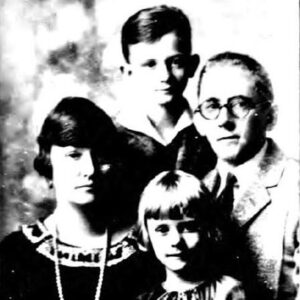 The Vonneguts in Europe without Kurt Vonnegut (Edith and Kurt Sr., Bernard, Alice, 1924
In turn, Kurt and Irma Lindener visited Indianapolis in October 1924, to introduce their son, Arthur Erich Lindener, born in Hamburg on August 11, 1923.
Arthur Lindener enlisted as a soldier for Germany in World War Two, and was captured by Red Army forces, but no records list him as a Nazi Party member. Arthur and his mother Irma, also not identified as a Party member, later were cleared postwar to live in the United States.
Newspaper records show that Irma Lindener filed for divorce from Kurt Lindener in 1950, but I found no evidence the couple ever finalized a divorce. Irma outlived Kurt Lindener who died in 1961, according to a Vonnegut family tree published in the Indianapolis News, December 26, 1978. Irma Lindener died at 94 in Indianapolis on November 2, 1984.
Kurt, Jr., then a toddler, likely had no memory of the 1924 visit by his cousin and his parents. However, when Kurt, Jr. was a teen in May of 1936, Kurt Lindener visited his parents as a house guest, returning to Germany on the German dirigible Hindenburg.
This shart stay of Lindener with Vonnegut’s parents may matter because the fictional family account in Vonnegut’s Deadeye-Dick (1982) The father character goes to Europe and gets a sexual illness (That happened to Kurt’s Uncle Alex Vonnegut). The narrator never visits Germany. That’s true of Kurt Jr. until he is captured and taken to a POW camp. The narrator says thos: “I sometimes think that I would have had a very different sort of soul if I had grown up in an ordinary little American house.” Like Vonnegut’s real life family, the whole family visits Germany without him. In Deadeye Dick, the father for a while becomes a convert to Hitler’s ideology. “According to Mother, he (Rudy’s Father) had undergone a profound spiritual change in Germany. He had a new sense of purpose in life.”

Irma and Kurt Lindener were both skilled at tennis. Herr Lindener later served as a member of the Hamburg-based German championship tennis committee, according to the Western Mail of Australia of December 15, 1938.
Irma, like her nephew Kurt, Jr., loved impromptu swimming matches at Lake Maxinkuckee, Indiana, the family’s summer vacation spot. Years later, the Indianapolis news claimed the Nazi press had hailed Irma as a heroine. She rescued and resuscitated a drowning boy on the Lindener’s Hamburg estate, according to the Indianapolis News of July 19, 1935.
Kurt Lindener, at the start of World War Two, was officially designated an “enemy war trader” under Enemy Trading Emergency Regulations, 1939. He was one of numerous plantation owners to be classified as an enemy and to have his Guatemala lands confiscated. Subsequently. the Congressional Record listed Lindener as an “undesirable,” that is an enemy of the U.S.
Lindener, the uncle of Kurt Vonnegut, Jr., was one of many Hamburg business leaders who profited from the takeover of Jewish business properties and general corruption associated with the confiscation. After his and other Guatemala plantations were seized by the Guatemala government, Lindener, an executive member of the Hamburg Stock Exchange, managed businesses in Poland at Litzmannstadt (Lodz), site of the notorious Litzmannstadt Ghetto, and Dombrow in west-central Poland from September 1941 to October 1942. His lining his pockets with Reichsmarks even brought him criticism from prominent Party officials, according to statements by the head of the Reich Commission for the Consolidation of German Nationhood (RKFDV), Ulrich H. E. R. Greifelt, later convicted as a war criminal in 1948. [Source: Aryanization in Hamburg: The Economic Exclusion of Jews and the Confiscation of Their Property in Nazi Germany by Frank Bajohr).
To my knowledge, Lindener never was charged or convicted of a war crime or other crime as a result of his managing of Polish businesses taken by Germany from Jewish business owners. Kay never wrote about his alien uncle who the U.S. government declared a persona non grata at the outset of World War Two. That may have been a family secret unknown to him or information that was simply forgotten.
I will continue to perform archival research to determine if any Vonneguts in the database were related by blood to Clemens Vonnegut, the paternal ancestor of Kurt Vonnegut, Jr.
So, with all respect to other Vonnegut scholars, their claims that Kurt Vonnegut had no relatives with Nazi Party affiliations are incorrect.
Kurt Vonnegut, Jr., in his essays and novels like Mother Night and Slaughterhouse-Five, pondered topics such as moral responsibility by governments for the devastating consequences of war.
He wrote an essay for The Guardian in 1992 in which he briefly discussed his cousin from Hamburg, the son of Kurt and Irma Vonnegut Lindener. Cousin Arthur, a radio operator, had been taken captive on the Russian Front. “If his parents said boo about anything the Nazis were doing or seemed to believe, I have not heard of it. Nor were they overly complicit in war crimes or crimes against humanity or whatever you want to call them. To their cred, I have to say, once the war was over, it did not occur to them to inflate small acts of compassion or reluctance on their part into hair-raising tales of anti-Nazi derring-do. They were simply whipped. That was about the size of it.”
No doubt future Vonnegut scholars will take a harder look at his autobiographical writings to speculate whether he had–or did not have–knowledge of the Nazi Party memberships of Rudolf Lieber, Erwin Herber, and Kurt Lindener.
I, for one, wish I had asked Mr. Vonnegut whether the name of tormented Rudy Walz in Deadeye Dick was inspired by either Granduncle Rudolph, his Uncle Rudy, or maybe both relatives.
So it went.
Hank Nuwer, an adjunct professor of journalism at the University of Alaska, Fairbanks, has his long-ago interview with author Kurt Vonnegut published in Conversations with Kurt Vonnegut, edited by William Rodney Allen. Disclosure: Because Nazi officials managed to destroy some Party membership records in 1945, surviving records are incomplete, according to DIE ZEIT.
*An online Vonnegut family history and also biographer Charles J. Shields located Lindener’s plantation in Honduras, but both are incorrect. Uncle Kurt’s travel records not only show him always going to Guatemala to oversee his properties, but wife Irma also traveled with Kurt to Guatemala on occasion after 1922.
Link to NPR errors
Nuwer’s Review of And So It Goes by Charles J. Shields
NUWER has previously been in DIE ZEIT.
Reader response:
Addendum from Hank Nuwer’s database search:
Nationalsozialistische Deutsche Arbeiterpartei & Kurt Vonnegut, Jr.
Here are the names of persons named Vonnegut listed in the database as members of the Nazi Party. Occupations are included if known. “Gau” refers to a Nazi-era regional district. No names were listed under Funnegut, which Kurt Vonnegut said was his ancestors’ original surname.
Adalbert Vonnegut, Burgermeister; Also registered as Albert Vonnegut
Born October 17. 1865
Place: Munster
Gau: Westfalen-Nord
Member no.: 2.161.024
Entry: May 1, 1933
Adalbert Vonnegut: Son of Felix Vonnegut and Sofie (Coppenrath) Vonnegut
Adalbert Vonnegut: Husband of Maria (Winnecken) Vonnegut — married 27 May 1895 in Borbeck, Oberhausen, Nordrhein-Westfalen, Deutschland  at age 29
Casper Vonnegut, Burgermeister
Born: November 12, 1898
Gao: Westfalen-Sud
Member no.: 2.538.082
Entry: May 1, 1933
Dr. Felix Vonnegut, Medical doctor, likely a gynecologist
Born: March 12, 1896
Place: Borken
Gau: Westfalen-Nord
Member no.: 591.433
Felix Adelbert Vonnegut
Felix Adelbert Vonnegut: Son of Adelbert Vonnegut and Maria (Winnecken) Vonnegut
[sibling(s) unknown]
at age 34Father of Maria-Theresia (Vonnegut) Beyer
Dr. Heinr. Ant. Vonnegut (Possibly Heinrich Anton)
Born: February 1, 1897
Place: Heelen
Gau: Westfalen: Sud
Member no: 2.933.413
Entry: May 1, 1933
Felix Vonnegut, Student
Born: November 8, 1911
Place: Bonn
Gau: Essen, Koln-Aachen
Member no.: 694.829
Entry: December 1, 1931
Felix Vonnegut, Student (Some information is different from previous Felix Vonnegut. This may be a misreading by database personnel reading membership cards).
Born: November 2, 1911
Place: Essen
Gau: Essen, Koln-Aachen, Mecklenburg
Member no.: 694.879
Franz Vonnegut, Locomotive (train) Engineer (same info listed twice)
Born: December 14, 1892
GAU: Westfalen-Sud.
Member no.: 5.048.719
Gertrud Vonnegut, housewife
Born: March 12, 1877
Place: Essen
Gau: Westfalen-Nord
Member no. 2.161.018
Entry: May 1, 1933
Heinrich Vonnegut, No occupation listed
Born: March 1, 1897
Place: Beelen
Gau: Westfalen-Sud
Member no. 2.932.413
Entry: May 1, 1933
Josef Vonnegut, Commercial agent; Gau department leader (listed twice in database)
Born: September 5, 1900
Place: Borken
Gau: Mecklenburg, Westfalen-Nord
Member no.: 478.546
Entry: March 1, 1931
Maria Vonnegut, Housewife
Born: August 23, 1874 (also registered as May 23, 1874)
Place: Essen-Bergenbeck
Gau: Westfalen-Nord
Member no. 5.413.211
Entry: May 1, 1937 and October 16, 1937
Paul Vonnegut, Student
Born: May 10, 1908
Place: Holzwickerde
Gau: Baden, Westfalen-Nord
Member no.: 2.161.019
Entry: May 1, 1933
Paula Vonnegut, Salaried worker
Born: November 25, 1915
Gau: Essen, Westfalen-Sud
Member no.: 3.015.261
Entry: May 1, 1933
Walter Vonnegut, Student (not to be confused by Vonnegut’s U.S. relative by that name)
Place: Holzminden/Weser
Gau: Baden, Westfalen-Nord
Member no.: 2.161.019
Entry: May 1, 1933
Here is important information on the database from DIE ZEIT.
Some 10.2 million Germans joined the NSDAP from 1925 to 1945. They were recorded in the indexes kept by both the “Gaus,” as the various regions of Nazi Germany were called, and by the central government. Neither index, however, has survived in whole. Shortly before the end of the war, party leadership had the complete stock of index cards – an estimated 50 tons of paper – removed from the Nazi party headquarters in Munich, known as the Braunes Haus, or Brown House, and brought to a pulp mill in the district of Freimann. But the operator of the mill, Hanns Huber, suspended the destruction of the documents once he realized what had fallen into his hands. In the autumn of 1945, the Americans recovered the valuable records and brought them in early 1946 to the Berlin Document Center, which they built for the purpose. Jürgen Falter, who has conducted extensive research into the party and examined the membership indexes for his authoritative work “Hitler’s Parteigenossen” (Hitler’s Party Comrades), estimates that 44 percent of the Central Index and 77 percent of the Gau Index has survived. DIE ZEIT has found that the first index contains around 4.5 million names while the latter contains 8.2 million names. Taken together, says Falter, around 90 percent of all former NSDAP members can be found.
If you are unable to find somebody in either index, it does not automatically mean that he or she was not a member of the party. Information pertaining to around a million members has been lost. Particularly large gaps exist in the Central Card Index between the letters Fa and G and between Ka and O.
Link here to a review of And So It Goes by Charles J. Shields