
 By Hank Nuwer
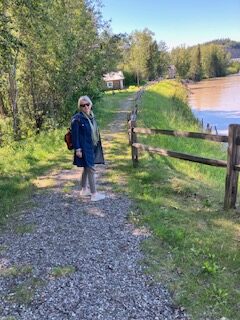
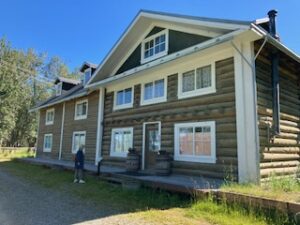
My wife Gosia and I often visit Delta Junction to shop for European foods at a local grocery. On the way home, we like pausing at Big Delta State Historical Park to stroll along the river bank and visit landmarks like Rika’s Roadhouse, a historic rendezvous locale for travelers, military personnel and locals from 1913 to 1947.
The area for years was known as McCarty, Alaska.
The roadhouse itself looks as imposing as it appeared when Rika Wallen, a Swedish immigrant born to the name Louisa Rika Jakobson, ran the establishment for decades. After her retirement, Rika settled at her house on the Tanana River, and at 90 years old saved her own life when, although an invalid, she escaped a fire that destroyed all she owned in the winter of 1965.
Rika Wallen died in 1969.
Until the fall of 2013, the Big Delta park drew up to 30,000 visitors. Back then, tourists helped the local economy by purchasing food at an on-site restaurant and gift shop.
All that visitor traffic ended when Holland America stopped using a motorcoach to transport visitors between Fairbanks and Dawson City—with a potty pause at the park.
Thus, now more often than not, my wife and I have the lovely park as our own scenic destination. The parking lot has no other cars. We take photos of the outbuildings and scenic riverside without any danger of other people photobombing our pictures.
The setting wasn’t always as bucolic.
Rika’s McCarty then was the site of a ferryboat that transported the freight of trucks arriving from Valdez over the Richardson Highway. Once safely on the far side, the freight traveled by truck to its Fairbanks destination.
However, in 1940, truckers learned that they now must pay an imposed toll per ton. The exact amount varied, depending what newspaper of the day I consulted.
No matter the amount, what matters is that the truckers felt their bread-and-butter was being taken unfairly away from them. They resolved to transport their freight without paying the toll, an action then popularly known as the “Tanana rebellion.” They used a 40-foot launch of their own to transport freight in August and September of 1940, according to the Alaska Miner, calling it the Independent Lumber Company.
That’s when Dennis Doyle, the deputy U.S. marshal stationed at Big Delta, decided to take action, and to enforce the law on behalf of the Road Commission, making arrests if needed.
Instead, truckers restrained and seized the deputy marshal, tossed his shotgun atop a nearby structure’s roof, and proceeded to move 10 loads of freight from the south to north bank of the river.
The truckers included Larry Rogge, the proprietor of Sourdough Express, William Miller, and Charles Simmons, Jr., the latter ironically the son of the toll collector.
Doyle was unhurt, although his pride no doubt was bruised.
Rogge, also a Fairbanks city councilman, defended the capture of Doyle, saying the deputy was never roughed up, merely placed under guard by Al Ghezzi Jr., Bob Miller, Red Stoltz and George Hiller.
Only trucker Max Miller refused to participate in the abduction of Doyle.
Doyle was freed when the last load crossed the Tanana. He was never under lock and key, Rogge stated. During the operation, a small number of cars were refused boarding the ferryboat.
Road Commission superintendent Frank Nash defused the situation in mid-October of 1940 of by removing the ferryboat, saying the reason was that the Tanana River was at a low stage.
Nonetheless, Deputy U.S. Marshal Pat O’Conner lodged a misdemeanor charge of disorderly conduct against 14 truckers, including Rogge. All pleaded not guilty.
A small number of cases went to court, including to a federal grand jury in Fairbanks, but local citizens refused to convict. The pressing defense needs of the country now took precedence as World War Two fast approached.
The rebellion ended with a celebration by victorious truckers.
Today, at the Big Delta State Historical Park, an informative display tells the story of that storied rebellion.
Hank Nuwer, former managing editor of the Fairbanks Daily News-Miner, is now rehearsing for the part of villain Henry Potter in an upcoming production of “It’s a Wonderful Life” by the Fairbanks Shakespeare Theater.