
Note: This chapter from my in-progress biography of Kurt Vonnegut must and will be cut significantly for space and for reader interest. I included it all here as a draft, not the final draft. Footnotes are placed here for position only. They will be placed at the end of the actual book. Hank Nuwer
Chapter: “How They Died” from “Kurt Vonnegut: The Man in the Hole. A Life of Reinvention.” by Hank Nuwer
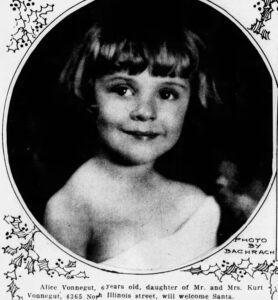 Alice Vonnegut, Christmas, 1923
September 15, 1958,
James Carmalt Adams would die at age 45 on an autumn morning as hot as a summer’s day. Clouds gathered like nooses as the temperature in central New Jersey hovered at 80 degrees.
Five months ago, Jim’s life began to unravel. Older than Alice by a few years, his arguments with wife Alice Vonnegut Adams had escalated over mounting bills. Alice’s little brother Kurt sided with his sister, blaming him for not being the husband he thought Alice deserved.
Worse, Alice, a chain smoker like her brother Kurt, now learned she had a terminal disease. Both her breasts were riddled with cancer. Alice self-medicated with alcohol and the marriage deteriorated further. Finally, the first week of that September, Jim brought his dying wife to a cancer ward at Monmouth Memorial Hospital.
This day, Jim had assumed Alice’s maternal duties. He put together breakfast, made proper lunches, and sent the three older boys to school. He grew frustrated, as he needed to commute to New York, but his youngest child’s sitter was late.
Jim now would need to take a different early-morning train to the ferry on the Hudson River that brought him into New York City for his editing job. The New York Purchasing Review wasn’t a glamorous place to work like the slick magazines that bought his brother-in-law’s short stories, but it paid most of the bills.
At last, the sitter showed up at the family home on 13 Sailer’s Way, dropping apologies. Jim phoned his office to let someone know his new arrival time. Jim climbed into his Woodie station wagon and drove to the commuter lot at the Victorian train station in Red Bank, New Jersey. He swung his briefcase as he raced to the platform. He checked his watch as he waited for New Jersey Central train number 3314. It had left the Bayhead station at 8:28 a.m.
Alongside Jim on the platform was a 73-year-old passenger named Elwood E. DeHart, a book tucked under one arm, on his way to his job as a movie projectionist.
The train arrived on schedule at 9:14 a.m. The engineer was Lloyd Wilburn, a career railroad worker. Wilburn was a colorful man who always wore an engineer’s cap or Stetson headgear.
In addition, to the engineer, fireman Peter Andrew, 42. was on board. His job required him to sit alongside the engineer in case, God forbid, Wilburn became incapacitated. The train was diesel-powered, and the former duties of a fireman keeping a boiler hot were no longer required. Andrew had served as a warrant officer during World War Two.
An unfamiliar face greeted Jim and fellow passengers. Conductor John Francis Kelly of Somerset, New Jersey, was a veteran train employee, but this was his first day punching tickets on his new route. Two years earlier, the dark, bushy-browed conductor had been injured and hospitalized in a train-truck crash outside Whitehouse, New Jersey.
[Somerset man lost making first trip, The Central NJ News Bureau, September 16, 1958]
As always, the boarding process at Red Bank was fast and efficient. Jim Adams and DeHart ambled past two locomotives linked back-to-back. The first was in operation, and the second, a deadhead, was an out-of-service locomotive. As the men settled into their seats, two tourists from North Dakota, Esther Selka, 62, and her daughter Carla, 20, stepped inside the passenger car. They boarded the wrong train. Had they taken the train recommended by a relative, they would have read about the accident in a newspaper, not been added to the list of dead passengers.
Footnote: The Passaic Herald News, September 16, 1956]
Seconds before the train’s doors closed, a passenger slipped inside the front car. He had lingered too long at a nearby coffee shop. A fellow passenger might have recognized the former major league star. George “Snuffy” Stirnweiss had been a major league player for nearly a decade. A few weeks earlier, Stirnweiss had appeared on the TV show “To Tell the Truth.” He described himself as just “a working man,” stumping the panel. The former athlete worked a day job as a foreign freight agent for Caldwell and Company in New York City. Players then often didn’t get paid enough to retire when they hung up their spikes.
At the appointed time, the train took off down the tracks. Wilburn lived at 92 South Bridge street, very near the Red Bank station. The engineer’s wife Addie, at home, heard the locomotive’s whistle at 9:16 a.m. The train gained speed as it rumbled toward Elizabethport, New Jersey, and arrived on time at 9:57 a.m.
There at the station, passengers boarded, including an off-duty train conductor named George Barry, a well-built man with a wife and four toddlers. Barry glanced at his watch as the train pulled out. It read 9:59 a.m.
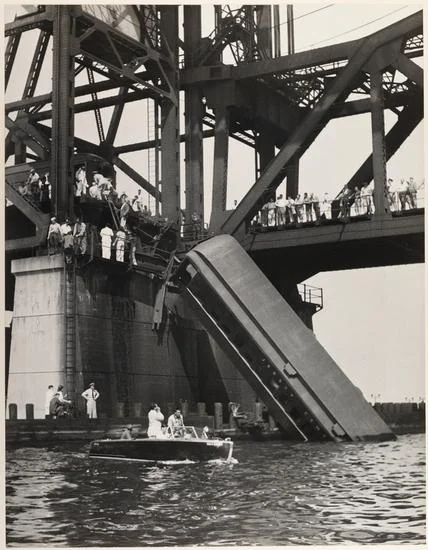
The train next roared toward a trestle ahead of the Newark-Bayonne Bridge, located above Newark Bay. The bridge was 1.5 miles in length. It had been built in 1864 and expanded in 1926-1927, containing two vertical drawbridges. When opened, the lifts gave ships 135 feet of space over the oil-slicked bay’s waters.
The towerman on duty was Joseph Halliday. He observed a drawbridge opening, and its movement triggered warning lights on all tracks approaching the bridge. Perhaps, had he followed written rules, he could have prevented the tragedy about to happen. He gave Wilborn the “all clear” signal despite the drawbridge being open, a fact he admitted in a post-disaster inquiry.
The signalman testified that what he had done was normal procedure. Halliday said he assumed that drawbridge captain Patrick Corcoran, age 56, would signal the engineer to stop.
But Corcoran failed to give the signal.
Corcoran would testify that he followed standard procedure in opening the bridge to let a vessel pass even if a train was due.
Why? “Ships don’t have brakes,” he said.
[
Donald F. Bolles, “Both Engineer, Fireman Suffered Heart Disease,” The Herald News, Passaic, New Jersey, September 25, 1958.
A mystery to this day, never to be solved at the inquest, is what went wrong in the lead diesel engine. The first obvious theory put forth in the media was that the elderly train engineer Wilburn had a heart attack and was incapacitated. After the crash, his body was found in the salvaged engine. An autopsy conducted by Angelo M. Gnassi, M.D., Jersey City Medical Center chief pathologist, determined that Wilburn died by asphyxia due to drowning, not of a heart attack, although his heart was enlarged. “We can only conclude that Wilburn was alive when he hit the water,” Gnassi told the Board of Public Utility Commissioners.
Moreover, the fireman Peter Andrew was supposed to sit right alongside the engineer and to apply the brakes if the engineer faltered, but his body was found outside the engine cab when retrieved by a diver. Authorities never would be able to pinpoint where Andrews was just before the accident. No cameras were present. Nothing was certain. Had Andrew bailed from the engine? Had he abandoned his post to relax in the deadhead engine? Or, if he was at his station, did he simply freeze and fail to perform his duty?
Dead men, as the saying goes, tell no tales.
The hearings revealed that the catastrophe was not the product of a single mistake but of a chain of accepted practices. Each employee expected another to prevent disaster.
One mystery was why the engineer had the train traveling at 45 mph, according to a salvaged speed tape. That was exactly twice the allowable speed on that stretch, In addition, three signals warned the engineer to halt.
The train’s speed tape also showed that either Wilburn or Andrew braked at least twice, including just before the train derailed in front of the open bridge.
When the train cruised 54 feet past the final red warning light, a derailing device activated. The derailing failed to halt the engine because the train was moving too fast. The noise it made terrified the passengers, and several people in the front car screamed with terror. They had a clear view of the open bridge.
Seconds passed, and a few passengers collided and died, or were knocked senseless, as luggage flew from the overhead shelves. Passengers crashed against one another like kernels in a corn popper.
The automatic device knocked the train off the tracks, but its momentum pushed it forward 500 feet to the yawning gap.
Three surviving train employees would testify at an ICC probe that they felt or heard the train’s brakes catch. The recovered locomotive showed a broken part on one of the engine’s brakes, but this could have been as the train shivered before plunging, or even after the crash during the salvage operation.
The lead locomotive, the deadhead, and two passenger cars dropped into the bay at 10 a.m., give or take one minute. Jane Cox Vonnegut later mistakenly wrote in her memoir, “Angels Without Wings,” that the derailment occurred at 10:13 a.m. She recalled that Kurt had tried to reach Jim by phone at the trade magazine about that very time.
Unfortunately, by the time Kurt called, Jim already had died.
Jane’s version of the timing of the phone call then become another family legend “more or less true.” Jane accepted it as evidence of a premonition by her husband.
How all drowning victims die was described by Sherwin B. Noland, author of How We Die.
Likely, if Jim died by asphyxia instead of a killing blow, he would have reacted to being under a mountain of water by holding his breath.
If trapped in the car or outside it and unable to fight his way to the surface, he would have soon became exhausted as carbon dioxide overwhelmed him. With water streaming into his airway, his larynx spasmed in a desperate attempt to create a dam.
“But within two to three minutes, the decreasing blood oxygen (relaxed) the spasm,” wrote Noland about similar victims.
Water then filled Jim’s lungs and diluted his blood supply with water. Jim’s blood’s chemistry and red blood cells were destroyed. Consequently, his circulation experienced a rush of potassium that destroyed all heart function.
Jim’s waterlogged body sank in the water-filled car or drifted to the bottom of the bay. Jim’s name was added to the list of victims on September 17th.
The passenger cars landed practically atop one another on the bay bottom. Steam immediately billowed toward the heavens. Air bubbles showed at the surface. a man’s felt hat floated on the water’s surface. A while longer, and Jim’s briefcase came to the surface with other passengers’ belongings. But seconds turned to minutes, and Jim stayed below the waters.
Divers later said the bay floor was fifty feet from the surface, a challenging distance even for the trim Jim and the former athlete Snuffy Stirnweiss to navigate, particularly if injured in the pile-up. Yet, somehow, Jim’s elderly fellow passenger Elwood DeHart abandoned his book and managed to find the strength to fight his way to the surface and survive.
A third car dangled on the precipice with one end buried in water. The car was in a vertical position, and so about two dozen passengers landed atop one another in 10-to-15-feet of water. Conductor George Barry’s watch stopped at 10:04 a.m. as he floundered underwater.
While some passengers lay dead or drowning in the third car, others scrambled to the dry end. Some broke the closest windows and leaped into the bay. Barry used the seats as a ladder and was out the top of the car at 10:06 a.m. “I didn’t expect to get out of there,” Barry said. “I thought I would drown.”
Despite his injuries, Barry pulled out other survivors and helped them duplicate his escape path.
The last two cars broke free of the dangling car and stayed safe and sound in front of the open bridge.
Footnote: Biographer Charles J. Shields incorrectly wrote in “And So It Goes” that an additional car was spared, but actually, two cars were spared as online newsreel footage demonstrated. Also, Mr. Shields researched early reports of the crash and reported incorrectly that the engineer had a heart attack, that the fireman was definitely in the cab, and that the fireman drowned instead of dying from blunt force trauma. Also, not all 46 victims drowned.
The first responder to reach the scene was Edward McCarthy, owner of the Elco Marina in Bayonne. McCarthy saw the mishap from his shop’s yard and jumped aboard his 16-foot inboard skiff. Patrolman Owen Ballweg also joined McCarthy in the boat. The two saved nine people floundering in the cold waters. One died on the skiff despite Ballweg’s attempts at resuscitation, according to the Asbury Park Press of September 16.
“It was a terrible scene,” McCarthy said later. “People in the hanging car were screaming for help, and the water was all blood. He made three trips and hauled aboard nine survivors.
[“Passaic Woman’s Kin Rescues Nine,” The Herald-News of Passaic, New Jersey, September 16, 1958]
Numerous other rescue boats and a Coast Guard cutter zoomed to the foot of the bridge to pick up the survivors, some badly hurt. The Coast Guard reported that altogether its rescue teams carried away 29 dead bodies. All told, 48 persons perished.
The U.S. Navy also dispatched teams of skin divers with Aqua-lungs to locate dead passengers underwater. Police cars, firetrucks, and ambulances filled the air with the noise of sirens. Coast Guardsmen also rushed to the scene and pulled up escaped passengers from the hanging boat with ladders and ropes.
The wreck was the nation’s biggest and most troubling story of the day. Newspapers dispatched their best investigative reporters, including Donald F. Bolles of the Passaic Herald News, later to be killed in Phoenix by a car bomb in 1976 while investigating organized crime.
A passenger named William H. Bowland in the rear car flew like a sack of meal across the floor, shattering his hip and pelvis. In August, 1946, the bond trader had suffered a previous crushed vertebrate in another Jersey Central wreck.
[FN: After, he sought medical aid at Hazard Hospital in Long Branch, New Jersey, where he served as vice president of the board of trustees. [James Ciavaglia, “Fatal Train Plunge Still Unexplained,” Asbury Park Press, September 16, 1958. ]
Another passenger in. that car, 70-year-old medical secretary Jessie Grapel, broke a leg. She survived, but it was touch-and-go for days.
Injured or unconscious passengers in the submerged car and the partially submerged car had little chance to survive. Desperate passengers knocked out nearly every window in the fully submerged car. Most families of the dead accepted the bad news without requesting an autopsy, not wishing to learn if their loved ones died instantly of trauma or suffered before expiring.
Train fireman Peter Andrew’s body was one of the later corpses to be retrieved. Unlike the engineer, the fireman was not in the locomotive when a crane hauled it up, deepening the mystery as to who, if anyone, was at the controls as it flew into oblivion. Investigators ordered an autopsy for him. Gnassi examined Andrew’s injuries. He opined that the fireman had died from shock and blunt force trauma, not of asphyxiation in the bay waters. In other words, the fireman died before the train filled with water, Gnassi testified.
Others passengers, perhaps Jim and Stirnweiss among them, felt the impact and then a split-second pause with a sensation of experiencing a vertical plunge. Immediately, they would have heard the screaming locomotive. As the water entered from every opening, blackness as impenetrable as night enveloped the fully submerged cars and both locomotives. Some passengers screamed. Some passengers begged for calm. Possessions floated like projectiles in the cabin. A few abandoned the car. They gasped a lungful of of air from a narrow air pocket above the water first.
Insurance claim agent Lloyd Nelson had survived a 1951 train wreck in New Jersey that claimed 85 lives.*
*Footnote: Kurt Vonnegut wrote an autobiographical note in his novel “Slapstick” that Jim’s death occurred on a train known as “the Broker’s Special,” However, the terrible accident involving a different train nicknamed “The Broker” happened in 1951.
As this train derailed, he saw the open bridge through his window and never hesitated. He threw open the window and slithered through it. “I swam to the surface and grabbed a hunk of piling that must have been knocked loose by the train,” Nelson said. “I floated on it for about 300 yards until I was picked up.”
As water threatened his space, Rafael E. Leon, a 55-year-old businessman from Venezuela living in New Jersey, grabbed hold of a seat with one hand and his wife’s hand with the other. “I was drowning and praying,” he later recalled. “My wife was beneath me in the water.” Then, a dead body landed atop his wife, and he lost his handhold.
“She slipped away,” he said in between sobs.
He escaped by bolting through a window opened by an earlier passenger and swam toward a hint of light at the top of the water. A rescue boat snatched him to safety.
“I did all I could,” Leon said, as if trying to convince a reporter.
[James Ciavaglia, “Fatal Train Plunge Still Unexplained,” Asbury Park Press, September 16, 1958.
Gustav H. Planitz of Fair Haven, New Jersey, was “thrown head over heels” as the train shuddered and skidded before falling into space. Like Lloyd Nelson and retired New York University Law School Dean F. Campbell Jeffrey, 70, Planitz also had been a passenger in the disastrous New Jersey crash of “The Broker” on February 9, 1951, when an engineer ignored a speed-limit warning and derailed the train.
The actions of many survivors seemed instinctive. Memories of exactly how they escaped later eluded them. While some fell apart in a panic, some found that even while shocked, they could respond to the crisis. The survivors took one deep gulp of air and prayed as they rose.
“I don’t know how I got out,” Planitz told a reporter. He, like other survivors, managed to figure which way was up to the surface. To swim, disoriented and downward, meant death.
Stockbroker Paul Land acknowledged he had no idea how he found the wherewithal to cave in a window of a submerged coach and swim to live another day. “I don’t know how,” Land said. “Maybe with my shoulder, maybe with my head.” The 72-year-old Land’s head was cut all over. He said that luck played a part in his escape. With the dead and dying surrounding him, Land found an air pocket to help him suck in enough air to last his ascent.
Footnote: The Courier-News, Bridgewater, NJ, Sept 16, 1958, “Survivors Relive near death in the waters of Newark Bay”].
A few passengers died close to the surface. These were the first corpses taken out of the waters with survivors by boaters. Boaters hauled out these few corpses along with survivors. However, underwater currents caused one passenger’s body to surface miles away.
Shaken passengers in undamaged cars four and five escaped, although some had been battered during the cars’ violent stop. More than a few people had broken legs. Many survivors overcame their own panic to comfort the hysterical souls among them. A few survivors scrambled from the standing cars and helped those emerging from the upper portion of the suspended car.
Almost certainly, a vision of his loving wife and loving children brought Jim Adams, alone and terrified, flashed before his eyes.
Jim’s body wasn’t recovered until September 20. He was one of the last bodies covered with a blanket by the recovery team.
By then, Alice Vonnegut was dead already five days, and the four Adams boys were orphans.
“Think of that,” wrote Kurt Vonnegut in “Slapstick.”
Forty-eight people died in the wreck.
“This really happened,” Kurt added.
My scholarly book also departs from “And So It Goes” in approach. I have taken years to find public documents and publications and lectures where I found Kurt Vonnegut’s words. His letters in books edited by Dan Wakefield and daughter Edie Vonnegut were important. Charles J. Shields conducted many memorable interviews. I respect his diligence even as I disagree with some of his conclusions in the biography. (He has declined to be interviewed for my book, and I respect his wish).
I conducted fewer interviews and concentrated on getting the facts right. I spoke in person only twice with Mr. Vonnegut. Based on those two conversations and years of research, I believe my scholarly biography will present a balanced portrait of Kurt Vonnegut. I still have work to do. Fans of Kurt Vonnegut still can help out by sending any letters, new material, corrections (including from “And So It Goes” or other Vonnegut books), or personal recollections to me at Hank Nuwer, PO Box 73446, Fairbanks, AK 99707. I still have interviews to do, and if readers have benefitted from my hazing work, etc., they are free to send donations with my thanks.