
By Hank Nuwer, excerpt from “Kurt Vonnegut: The Man in the Hole. A Life of Reinvention.” In-progress bio by Hank Nuwer
On the third day of the German offensive at the Battle of the Bulge, Colonel Charles C. Cavender, commander of the 423rd Infantry Regiment, asked for a volunteer to carry a white flag of surrender to German negotiators. The Germans had the 106th Infantry Division pinned down at the Schnee Eifel in the Ardennes.
One man who claimed that he carried the white flag was Major William J. Garlow, executive officer of the 2nd Battalion, 423rd Infantry Regiment.
Kurt Vonnegut and army buddy Bernard O’Hare were members of that 2nd Battalion under Major Garlow.
Garlow was the grandson of the legendary Buffalo Bill Cody, a self-promoter who gained fame and fortune with his traveling Wild West shows. As a young man, Cody enjoyed a friendship with Wild Bill Hickock, another Western character of legend and myth.
While more research is needed for a positive identification, I found that Garlow may be a previously overlooked candidate for one of the real-life inspirations behind Wild Bob in Slaughterhouse-Five. During two extended research visits to Indiana University’s Lilly Library, I found no document establishing that Garlow was Vonnegut’s model.
Consider these compelling coincidences, however.
Even among the memorable characters in Slaughterhouse-Five, the dying prisoner of war Wild Bob stands out.
Vonnegut used great fictional license. Wild Bob had not merely carried a white flag of surrender; he had been the colonel who surrendered his fictional 451st Infantry Regiment.
At Camp Atterbury, then-Major Garlow stood at a microphone and led Vonnegut and the 106th through a demonstration involving the use of Tank-Artillery-and Infantry units in a coordinated attack upon enemy.
It would not have been out of character for Kurt Vonnegut or another dogface to coin a nickname like “Wild Bill” for Major Garlow.
Before dying of pneumonia in German captivity, the Wild Bob of Slaughterhouse-Five deliriously imagines himself addressing his lost regiment. He dreams that someday they will hold a regimental reunion in his hometown.
That hometown is Cody, Wyoming.
“He was going to barbecue whole steers,” Vonnegut wrote.
And war’s end, William J. Garlow, Buffalo Bill Cody’s grandson, was promoted to colonel.
The Surrender
Garlow told the Dallas Morning News on October 4, 1949, that he personally had carried the white flag in the surrender of some 5,000 Americans during the early days of the Battle of the Bulge. Historical accounts generally place the number of Americans captured in the surrender of the 422nd and 423rd regiments at between 6,000 and 8,000.

The Dallas Morning News described Garlow as “lean, brown, westernish.” He graduated from Harvard Law School and after the war became an attorney in Cody.
An amateur genealogist, Garlow had written about his famous showman grandfather for the Casper Star-Tribune on March 12, 1939.
Before the Battle of the Bulge, he supervised live-ammunition training at Camp Wolters, Texas.
“He thinks the 5,000 men he surrendered may have been the largest American force ever surrendered,” the Dallas Morning News reported. “Then a major, he had gone into France with the 106th Infantry Division.”
After the war, Garlow operated a guest ranch and pursued other business enterprises in Wyoming.
Eventually Colonel Garlow renamed himself Bill Cody II, and William J. Cody. His niece served as the curator of the Buffalo Bill Museum in Cody.
In 1969, the year Vonnegut published Slaughterhouse-Five, Bill Cody traveled the United States as a representative of the Daisy-Heddon Company. His wife, the former Barbara Sass of Austin, Texas, accompanied him on his speaking engagements.
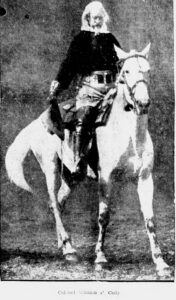
Buffalo Bill
His face lined by years in the sun, Cody consciously resembled his famous grandfather. He wore a Stetson and clothing made from animal fur, according to the Richmond Times-Dispatch of October 26, 1969. He also hunted big game in Wyoming.
Like Vonnegut, Cody became an outspoken advocate for preserving the environment.
He said that parents who bought their children Daisy air rifles sometimes discovered that the experience changed the entire family.
“The family moves outdoors with the youngster and a whole new world opens up,” he told the Times-Dispatch. “They enjoy the heritage nature has provided, and they want to see our rivers cleaned up and the pollution removed from the air.”
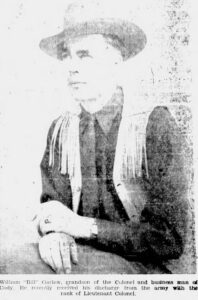
William J. Cody, from Cody Gazette
William J. Garlow Cody, born January 4, 1913, in North Platte, Nebraska, died September 18, 1992. His grave in Cody’s Old Trail Town Cometary bears the name William Garlow Cody,and it is located a short walk from the reinterred remains of Liver-Eating Johnston, celebrated in the Robert Redford movie Jeremiah Johnson.
I have found no evidence that Garlow ever believed he was the model for Wild Bob. Nor have I found evidence that Vonnegut ever identified him as such.
But Garlow served in Vonnegut’s 106th Infantry Division. He was a visible spokesperson using a microphone at Camp Atterbury to address the gathered troops. He apparently was involved in the surrender that sent both men into different German camps for prisoners. He hailed from Cody, Wyoming. And he was so obsessed with being the grandson of Buffalo Bill Cody that he eventually took Cody’s name and dressed like the frontiersman who toured the world with The Congress of Rough Riders of the World.
Twenty-four years later, Vonnegut gave the name Wild Bob to a doomed American officer whose final dream was to reunite his lost soldiers in Cody, Wyoming.
Using Wild Bob (instead of Wild Bill) for the dying colonel may have been Vonnegut’s attempt to shield the identity of his former 2nd Battalion executive officer.
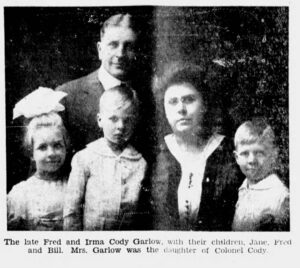
William J. Garlow, bottom right