By Hank Nuwer, excerpt from “Kurt Vonnegut: The Man in the Hole. A Life of Reinvention.” In-progress bio by Hank Nuwer. Revised Oct. 31, 2026.
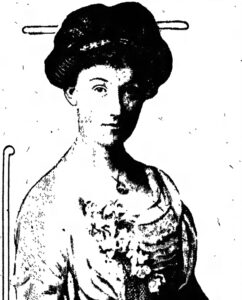 Socialite Edith Lieber, a portrain in an Indianapolis newspaper
Edith Vonnegut’s Death: Suicide or Something Else?
An excerpt from Kurt Vonnegut: The Man in the Hole: A Life of Reinvention
By Hank Nuwer
Preface
Was Edith Vonnegut’s death a suicide?
Given the gravity of such a conclusion, shouldn’t journalists examine her death certificate before writing about the circumstances of her death?
And what about their duty to report accurately the professional findings of Indianapolis coroner Roy B. Storms, M.D.?
To say that Storms knowingly recorded a false cause of death, as Kurt Vonnegut Jr. later alleged, was to accuse the coroner of serious professional misconduct.
Journalists know the old expression: “If your mother says she loves you, check it out.”
It should follow that if a son says his mother died by suicide, check out his claim.
I
Few details exist concerning Edith Vonnegut’s last evening on earth in the tidy, middle-class Vonnegut home in Indianapolis.
Edith’s final words to family members before retiring to her separate bedroom were never recorded. No suicide note is known to have been found. She left behind a typewriter on which she had written short stories that never sold.
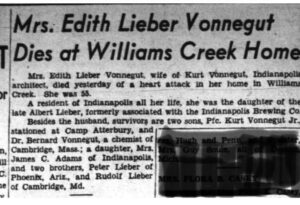
At some unknown hour, she took her last breath. Her family discovered her dead on Mother’s Day, May 14, 1944.
Before her marriage, Edith had been the beautiful, flame-haired daughter of a prosperous brewery owner. Eager gentleman callers from at least three countries had wooed her.
After Edith’s grieving family discovered her body and notified authorities, another gentleman arrived at the door, this one carrying a medical bag.
Kurt Vonnegut Sr., Edith’s husband, and their two adult children admitted Marion County coroner Roy B. Storms, M.D.
The couple’s married daughter, Alice Vonnegut Adams, was living temporarily with her parents while her husband, Lieutenant James C. Adams, was away in military service.
Kurt Vonnegut Jr., known to family and friends as Kay, had wangled leave from Camp Atterbury to spend Mother’s Day at home.
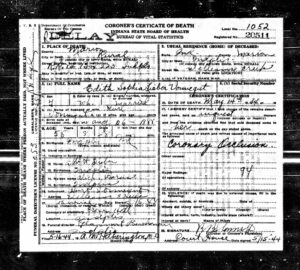
After examining the circumstances and interviewing the elder Vonnegut, Storms concluded that the cause of death was a “coronary occlusion,” an obstruction of blood flow in a coronary artery.
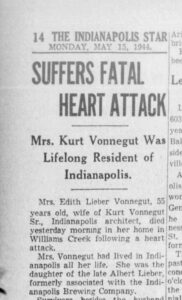
Simply put, the coroner attributed Edith Sophia Lieber Vonnegut’s death to a heart attack.
What remains unknown is whether Storms considered alcohol or sleeping pills as possible contributing factors. What is known is the conclusion he recorded on the death certificate.
Edith Vonnegut’s obituary appeared in the Indianapolis Star on May 15, 1944, under the headline “Suffers Fatal Heart Attack.”
Many years later, Kay claimed his mother had developed a habit of mixing alcohol and barbiturates in the evening. The combination, he said, loosened her tongue. She supposedly directed her anger and frustration at his father in verbal attacks Kay described as “as corrosive as hydrochloric acid.”
One can only speculate about Kay’s final evening with his mother. He never provided readers with a detailed account. On previous weekends home on leave, he had spent time drinking with old friends or listening to hot jazz at an Indianapolis club before returning home.
Perhaps he went to sleep expecting to celebrate his mother’s special day the following morning.
It was tall, athletic Alice who nudged open Edith’s bedroom door and found her lying cold in bed. She summoned Kay. Together, the two children faced the terrible task of telling their 59-year-old father that he was now a widower.
The loss eventually turned Kurt Sr. into a recluse, Kay would later write.
On May 16, 1944, Edith’s wake was held at Flanner & Buchanan Mortuary.
Her funeral service followed at All Souls Unitarian Church in Indianapolis.
Fifteen months earlier, the elderly pastor-emeritus, the Rev. Dr. F. S. C. Wicks, had presided over Alice Vonnegut’s marriage to Jim Adams at her parents’ home, beside a makeshift altar overflowing with bouquets.
Three decades before Edith’s death, Wicks had presided over Edith and Kurt’s lavish wedding ceremony. Theirs had been the first marriage performed at All Souls.
Edith’s grieving family buried her remains in Crown Hill Cemetery. Her tombstone was a small rock inscribed with her name.
On May 30, 1944, Kay wrote to his on-again, off-again girlfriend Jane Cox and confessed how he had cried and cried over the loss of his mother.
Even in his grief, Kay congratulated Jane on her imminent graduation from Swarthmore College.
The letter was published by his daughter Edie Vonnegut in the 2020 collection Love, Kurt: The Vonnegut Love Letters, 1941–1945.
In a few terse sentences on lined paper, Kay described finding Edith curled beneath the covers. He emphasized that there had been nothing strange or unnatural about the position in which she lay.
He confessed to his “Woofy” that he regretted never telling his mother more of what was in his heart.
He alluded to Edith’s emotional outbursts but attributed them to a particularly severe menopause. Years would pass before he began connecting her behavior to drugs and alcohol.
In the letter, he memorialized her limitless devotion to her children and her unwavering sense of morality and justice.
He now lamented the loss of a mother whose love he had perhaps taken too much for granted.
There is another important consideration in evaluating Edith’s death: cardiovascular disease appeared in her family history.
Her grandmother, Sophia Barus, died of pneumonia and an unspecified heart condition at age 85 on July 13, 1920.
Her unmarried aunt, Jennie Barus, an Indianapolis piano teacher, died of pneumonia, with myocarditis listed as a contributing factor, on January 17, 1938. The informant named on Jennie’s death certificate was Kurt Vonnegut Sr.
Edith’s father, Albert Lieber, died of atherosclerosis and chronic myocarditis.
And Kurt George Francke, the son of Albert Lieber’s sister Caroline, would die of a myocardial infarction at age 65 in 1955.
These deaths do not establish that Edith suffered a fatal coronary occlusion. They do, however, provide family medical history that could be relevant to the coroner’s finding.
Vonnegut family historian John Rauch wrote that Edith died from an overdose of sleeping pills. He allowed that taking too many pills might have been accidental.
Kurt quoted Uncle John’s explanation verbatim in an autobiographical chapter of Palm Sunday.
Rauch’s family history, incidentally, contained factual errors that Kurt repeated without correction. For example, Rauch listed Edith’s age at death as 56. She was actually 55, having been born August 26, 1888.
More important than Uncle John’s mistakes, however, is that an intentional overdose was not the cause of death recorded by Coroner Storms.
Nor does the surviving official documentation establish that Edith died by suicide.
Storms ordered no autopsy. Without one, important questions about the possible effects of medication or alcohol remained unanswered. Even an autopsy might not have resolved whether an overdose, if one occurred, was deliberate or accidental.
Kurt believed his mother had suffered from depression. That possibility deserves serious consideration, although depression alone cannot establish suicidal intent.
Edith in 1944 was hardly a recluse living behind closed curtains.
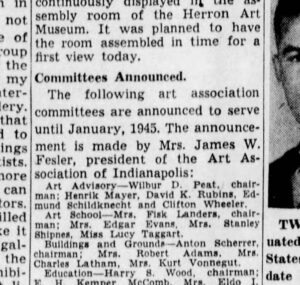
About ten days before her death, she and her husband sponsored a social event for the Portfolio Club of Indianapolis.
Family events in Indianapolis and at Lake Maxinkuckee had always mattered to Edith.
The previous Christmas, she accompanied her husband to Cambridge, Massachusetts, for the marriage of their son Bernard, a scientist of note, to Lois Bowler.
And Alice was visibly pregnant, only days from delivering Edith’s first grandchild. James Carmalt Adams would be born at an Indianapolis hospital on June 1, 1944, without his father present.
These events reveal a woman still involved in the lives of her family and community. They cannot, of course, tell us what private despair she might have experienced.
Nor can they settle the question of how she died.
II
Many questions arise that neither Uncle John nor Kurt Vonnegut satisfactorily addressed.
Who was the coroner? What was his background? Most important, did he get his finding wrong—or, worse, deliberately conceal the circumstances of Edith’s death?
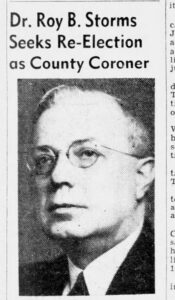
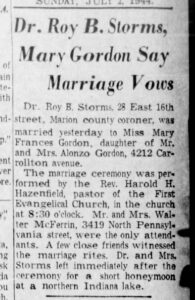
Dr. Roy Basil Storms was the son of a farmer who lived about an hour north of Indianapolis.
He graduated from Indiana University Medical School in 1915. During the Great War, he served as a captain in the Army Medical Corps in France and commanded an ambulance corps.
After mustering out, Storms found his reputation and private medical practice imperiled when he took offense at an insult and was charged with assault and battery.
The Journal of the American Medical Association carried a brief account of his acquittal by an Indianapolis trial judge in 1922.
At the time of Edith’s death, Storms was a robust 56-year-old man engaged to a photogenic 30-year-old woman, Mary Frances Gordon. Their wedding was scheduled for July 1, 1944.
Active in the Indianapolis Athletic Club and Columbia Club, Storms likely had at least a nodding familiarity with Kurt Sr., who also belonged to those social circles.
That acquaintance raises a legitimate question about possible social connections. It does not establish that Storms felt obligated to conceal a suicide to spare the Vonnegut family embarrassment or political fallout, as Kurt suggested during an appearance on PBS’s NOW program in 2005.
What political advantage would Storms have gained by protecting Kurt’s father, an architect who struggled to land commissions?
Storms was elected coroner in 1940 and served for 18 years.
“Dr. Storms served so long and so well that his name almost became synonymous with the job,” the Indianapolis News would say in a tribute after his death.
The year before Edith Vonnegut died, Storms had been an important source for reporters investigating a mysterious, never-solved death.
WAC Corporal Maoma Ridings, 32, was murdered on August 28, 1943, at the fashionable Claypool Hotel.
“He was patient and precise in answering the reporters’ questions and gained the confidence of newsmen,” wrote an Indianapolis News columnist.
“While some law enforcement officers could not resist the temptation to grandstand, he was interested only in the facts.”
Not all assessments of Storms were so complimentary.
He also drew criticism for rulings that found police shootings justifiable.
In 1953, he defended the actions of two Indianapolis policemen who beat an uncooperative disabled veteran to death with blows to the head from their nightsticks.
The case reached court, where the outcome favored the police. The circumstances nevertheless raised troubling questions about Storms’s judgment.
On other occasions, Storms showed no reluctance to identify deaths involving alcohol and barbiturates.
Consider the case of Mary Juanita Nance Yadon, 41, a married woman found dead in a hotel room with a man described in contemporary accounts as a petty criminal.
After conducting an autopsy, Storms recorded this finding on her death certificate:
“Acute alcohol & barbiturate poisoning self-ingested during drunken orgy. Consumed overdose of alcohol & barbiturates.”
In another case, that of Halene May Wilson Cox, who died July 8, 1954, a death certificate attributed her suicide to a “self-digested overdose of barbiturates.”
These examples show that Storms was willing to record overdoses and suicides explicitly when he believed the evidence warranted such findings.
One perplexing case, however, illustrates the limitations of historical death investigations.
Three months before Edith’s death, Storms investigated a fatal shooting at a small, older, three-bedroom house on West 29th Street in Indianapolis.
Donald Beeker, 34, had reportedly been seriously ill for two years. He was found dead from a gunshot wound to the head, with a .22-caliber rifle positioned beneath his chin.
Storms recorded the death as accidental.
“Gun shot wound under chin and into head … while loading .22 calibre rifle[,] which was accidentally discharged,” he wrote on the death certificate.
One of Beeker’s brothers was Indianapolis police chief Donald Beeker.
The police chief defended the finding, saying his brother had seized the weapon to protect his property from burglars known to be operating in the neighborhood.
The circumstances might invite skepticism, but the surviving account does not establish that Storms deliberately falsified his conclusion.
In short, Storms was a respected and long-serving coroner whose decisions were not beyond question.
He was neither an infallible medical authority nor, on the available evidence, a man shown to have concealed Edith Vonnegut’s suicide.
Dr. Roy B. Storms died in 1970 after years of illness, during which his wife, Mary Gordon Storms, cared for him as he struggled with the effects of a stroke, pancreatic cancer, and anemia.
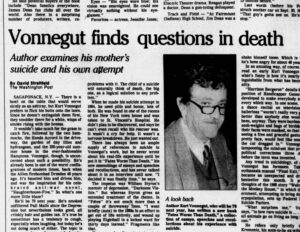
By then, Kurt Vonnegut was increasingly speaking and writing about his mother’s death as a suicide.
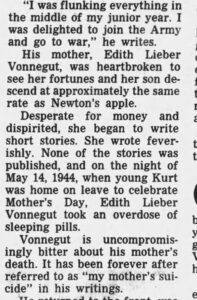
In his 1974 essay “Reflections on My Own Death,” Kay portrayed Edith’s fatal use of pills as her escape from a loveless marriage to Kurt Sr.
His father was by then long dead of cancer and pneumonia, unable to respond to his son’s characterization of the marriage.
Sister Alice had also died of cancer.
The people closest to the events of that long-ago Mother’s Day were disappearing, taking their recollections with them.
Storms’s widow lived until 1991. Whether she followed Kurt Jr.’s literary career, or knew of his accusations concerning her husband, remains unknown.
What is certain is that the public account of Edith’s death increasingly came to depend upon Kurt’s recollections.
And those recollections were not always expressed with certainty.
III
The old saying that there is a thin line between certainty and doubt certainly applies to the death of Kurt Vonnegut’s mother.
Over time, Edith’s younger son came to embrace suicide as the explanation for her death.
The belief became intertwined with the way Kurt understood his own lifelong struggles with depression and his complicated feelings toward his parents.
And so it goes that Edith’s suicide has been repeated in biographies and news stories as though no reasonable uncertainty remained.
Yet Kurt himself was not always certain.
On April 7, 1965, around the time he was engaged in a modest publicity campaign for God Bless You, Mr. Rosewater, Kurt wrote a remarkable letter to a former student from the Hopefields Riverview School.
The young man was William “Bill” Corrigan, who had written to Kurt about his own mother’s suicide.
Kurt responded with sympathy and concern.
He wrote that his own mother “may or may not” have committed suicide.
He added that “if” Edith’s death had been a suicide, sleeping pills were the means.
Those few words matter enormously.
More than two decades after his mother’s death, Kurt was still expressing uncertainty about whether she had deliberately taken her life.
Within approximately five years, he would begin speaking publicly with much greater certainty.
The April 7 letter also revealed Kurt’s sympathetic, caring side.
He warned Corrigan that losing a mother to suicide might make the same fatal choice seem more imaginable to her child.
In strongly worded language, he urged the young man to resist such thoughts.
Kurt also wrote that the coroner who attended Edith had shown little interest in determining whether she had killed herself.
The surviving death records establish that Storms certified a cause of death. They do not establish the full extent of his investigation, or whether he considered and rejected an overdose.
The timing of Kurt’s letter is intriguing.
He had recently returned from Indianapolis, where he visited his father, who had been diagnosed with cancer.
Could father and son have revisited the circumstances of Edith’s death?
It is possible. No surviving evidence cited here establishes that they did.
What matters is that Kurt, writing privately in 1965, did not claim the certainty he later expressed publicly.
His children have also acknowledged uncertainty surrounding their grandmother’s death.
Mark Vonnegut wrote in his 2010 memoir:
“His mother had allegedly killed herself.”
He explained his choice of the word “allegedly”:
“I say allegedly because not everyone thought so and I wanted that doubt to lessen the chances of my father doing the same.”
Mark’s words suggest that doubts about Edith’s death survived within the family itself.
This is not a minor distinction.
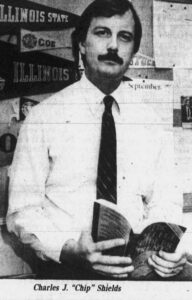
Charles J. Shields, author of And So It Goes, and numerous other journalists and scholars have described Edith’s death as a suicide. Too often, the account has been repeated without explaining the uncertainty in the surviving evidence.
Shields conducted many memorable interviews, and I respect his diligence even where I disagree with his conclusions.
But the obligation of a biographer is not merely to repeat a subject’s recollections. It is also to examine them against contemporary records and other testimony.
In Edith’s case, the official death certificate attributed her death to coronary occlusion.
Kurt’s later recollections and the family history compiled by John Rauch point toward a possible overdose.
The surviving evidence does not conclusively reconcile those accounts.
Nor does it establish whether an overdose, if one occurred, was accidental or intentional.
That uncertainty should accompany any responsible account of Edith Vonnegut’s death.
Kurt’s changing understanding of the event is itself part of the story.
His mother’s sudden death haunted him. It became intertwined with his reflections on depression, marriage, family, and suicide.
The novelist who devoted so much of his life to examining the human condition also struggled to make sense of what had happened in his own family.
One indisputable certainty remains.
Whatever happened in Edith Vonnegut’s bedroom during the night of May 13, 1944, went into the earth with her body.
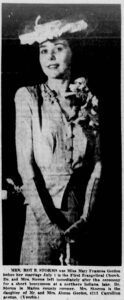 Mrs. Mary Gordon Storms
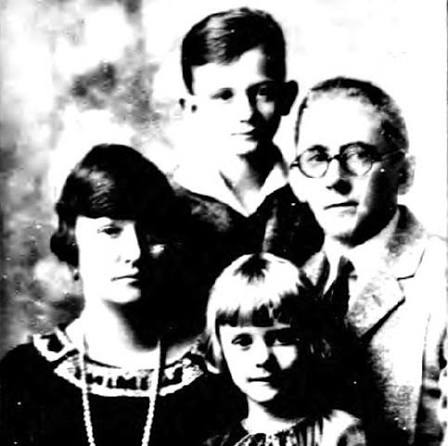
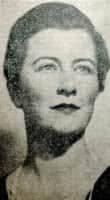 Mrs Edith Lieber Vonnegut
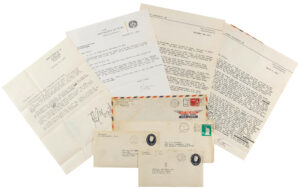
Bill Corrigan correspondence
 Nov. 9, 1983 clipping