
Excerpt from a biography-in-progress by Hank Nuwer: “Poor Old Edgar Derby”
“Kurt Vonnegut: The Man in the Hole. A Life of Reinvention.” by Hank Nuwer
Chapter: “Poor Old Edgar Derby”.
Catch an error? Suggest any changes? By all means, write Hank Nuwer at Nuwerhank@gmail.com
If a slave prisoner in Dresden found a cache of food, he tipped other prisoners after returning to the shattered streets. A common ruse was for a POW to tell a guard he needed to go underground to relieve himself.
Once in the cellar, the prisoner devoured stored food as fast as he could. Rarely did the German soldiers follow a POW underground. The stench and risk of disease kept them away. After eating his fill, if more food remained, the prisoner would tell his comrades who then also had a sudden urge to take a dump. The older guards caught on to the scheme, but they often turned a blind eye.
The danger came when a prisoner pocketed food, goods, or valuables and left the cellars. Then the guards, fearing the dreaded S.S. officers on inspection, needed to take action or risk execution themselves for dereliction of duty.
Plundering was a criminal offense for German soldiers, citizens and prisoners. It could bring a sentence of death or a beating and incarceration. Nonetheless, hunger won out over fear for prisoners such as Pfc. Kurt Vonnegut.
Always the storyteller, after weeks of living on bread made from sawdust, water masquerading as soup, and ersatz coffee, he and his war buddy Bernie O’Hare, a slim and wiry fellow from Pennsylvania, shared descriptions of meals they would eat after the war. Often, if Kurt became too animated, someone in a nearby bunk at the slave barracks would snarl and ask him to knock it off.
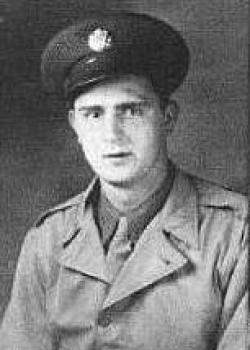
Michael D. Palaia served with the 423rd Infantry Regiment, 106th Infantry Division. He was a big fellow with a large appetite and a comic book collection at home. As a teenager he hit towering homeruns in a semipro league, and a Chicago Cubs scout came to watch him play ball. He was a tough kid from South Philly who worried his commando pals because he couldn’t seem to stop sassing the German guards. He had voluntarily joined the Army. The only trouble he got into at school was for kissing his teacher on a dare. He dropped out at age 16 to get a job.
Footnote: Ralph Palaia, “Shadows of Slaughterhouse Five,” by Erwin E. Szpek, Jr., Frank J. Idzikowski, and Heide M. Szpek, Bloomington, Indiana, iunivers, 2008, p. 347.
German soldiers captured the youth from South Philadelphia at the Battle of the Bulge in the same sweep that bagged Kurt Vonnegut as a prisoner. Palaia, 19 years old, had brown eyes and black hair. He stood six-two with a good build. Like Kurt, he was one of the taller prisoners in the Dresden camp roll.
When Kurt Vonnegut wrote “Slaughterhouse-Five,” he clearly recalled Palaia’s ill fate, but he took creative license and invented a much older character in Slaughterhouse-Five—the prisoner Edgar Derby, a 45-year-old high school teacher. However, Vonnegut’s Derby was a big man in excellent physical condition, and that had been true of the kid from South Philly.
It is possible that a teacher at Dresden that also inspired Kurt’s creation of Derby was a prisoner of war named Max Diller.
Diller, a high school teacher and principal from Alma, Kansas, had been born August 24, 1915, and was 29 in 1945 while in the Dresden camp. The Army drafted Diller despite his having a wife and two. daughters.
His wife had received notification that her husband had been killed with his outfit, Company I, 423rd Infantry, when encircled by Germans. In reality, he and other soldiers had slipped past the Germans and ran into a Jeep filled with German soldiers dressed in American uniforms. Once more, Diller escaped, but many companions died under fire from a 50-caliber machine gun. He then was captured by a detachment of Luftwaffe that had been grounded by the bad weather, and he was able to write his wife Vivian and daughters Connie and Judy who had been grieving his death for many months.
Footnote: Mary Strnad, “Diller Recounts Life of Starvation , Slave Labor in WWII POW Camp,” The Bellville (Kansas) Telescope, November 5, 1992.
Diller’s slave duties in Dresden found him working in a bakery. Diller became proficient at stealing small amounts of bread. When he and a companion were put to work digging for corpses later, the other man barely escaped a shooting when caught with a tin of fish.
“You took your chances,” Diller later said about his plundering. “There isn’t one of us that couldn’t have been shot.”
Diller recalled how Palaia, dressed in an oversized Soviet coat, spooned food out of a stolen jar at a fire on the street, trying to get warm.
Prisoner of war Louis John Grivetti, 19, a former employee of the Pittsburgh Coal Company, also told this biographer that Palaia had stashed his find under a rock and then taken it out again.
“If he’d eaten them in the cellar, why, it would never have happened,” Max Diller recalled long after the war.
Footnote: Max Diller, “The Execution of Michael Palaia,” in “Shadows of Slaughterhouse Five,” by Erwin E. Szpek, Jr., Frank J. Idzikowski, and Heide M. Szpek, Bloomington, Indiana, iunivers, 2008, p. 347.
The grave diggers were Harry E. J. Kingston, Henry Edward Hall, Joseph Topicz and Floyd T. McLea. The truth was scattered in interviews and commentary by Dresden POWs in the 2008 book “Shadows of Slaughterhouse Five” by Ervin E Szpek, Jr. and Frank J. Idzikowski. The names of the grave diggers emerged rom the investigations of military war crime investigators Joseph Carpenter, William Busch and Joseph S. Smith. Bernard O’Hare was also questioned, but all his information was hearsay.
Before leaving the barracks with guards, Palaia gave a slip of paper to fellow prisoner Harry Kingston, a grocery clerk before the war. He trusted Kingston because they were both from Philadelphia. “Harry, I don’t know where I am going. They tell me I am going on a new commando. If you don’t hear from me again, see my mother, don’t forget 1825 S. 17th. So long for now. See you later. Michael [PS] Don’t lose the address.”
Kurt Vonnegut was not present at the execution. He learned of it second hand. In Slaughterhouse-Five, The German SS who arrested Palaia wanted to frighten the prisoners and make them quit taking food and plunder from the cellars.
Vonnegut upon his arrival home in Indiana from captivity as a Nazi slave in 1945 told his Uncle Alex Vonnegut about Palaia’s demise. While it is possible that Kurt claimed to be a grave digger, it’s also possible that Uncle Alex saw how overwrought his nephew was talking about the execution and wrongly assumed his nephew was present when Palaia died. At any rate, the execution of Edgar Derby became unquestionably one of the passages in Slaughterhouse-Five that wrings emotion out of readers.
In Slaughterhouse-Five, it is Billy Pilgrim who served as a member of the burial party. In the novel, he told his wife Valencia that Derby saw him with a shovel before the execution, and that Derby was “doped-up” and “sort of glassy-eyed.”
German guards took Hall and the burial party out of the barracks without telling them the details of their mission. The Americans carried their shovels and at least one pick.
Hall, a small man with pinched facial features, didn’t know Palaia at all. All he remembered was the boy’s size and taciturnity. Hall hailed from North Carolina, and before the war picked cotton as his daddy did. Born in 1925, he was one of the youngest prisoners imprisoned at Slaughterhouse-Five.
“We walked for quite a while and crossed a bridge,” Hall later noted. The party at last approached a hilltop that looked like part of a military training obstacle course.
“I don’t recall seeing water but did notice the bomb craters that missed it,” Hall said. “We came to a wooded place with barracks. Palaia was led past us by guards. He didn’t say anything and we didn’t either. I don’t think he realized what was going to happen. He had on his old blue looking uniform, a coat that was like ours but not as long . . . I did see Michael standing up there by a large tree with his hands tied behind his back but I couldn’t see him from where we were digging the graves. We had a hard time digging because the ground was still frozen and we kept hitting roots from that tree. We saw them shoot.”
Hall thought the other executed prisoner was a Russian and understood from the guards that his crime was stealing a pack of matches. The most reliable sources, however, identified the victim as Polish. Since the gravediggers knew neither Polish or Russian, this may be why a discrepancy occurred.
Hall watched the Germans take the victim’s English shoes, wishing he could give them to several fellow prisoners whose shoes were tattered.
Footnote: Henry E. Hall, “The Execution of Michael Palaia,” in Shadows of Slaughterhouse Five, by Erwin E. Szpek, Jr., Frank J. Idzikowski, and Heide M. Szpek, Bloomington, Indiana, iunivers, 2008, pp. 350-351.
Joseph Topicz of Cincinnati was another of the older prisoners. He was born in 1915 and worked as a blue-collar worker before the war. His wife Ethel was born in Tennessee. They had a young daughter named Carol who was born in 1941. Topicz kept to himself. He mistrusted Kurt and his successor as confidence man, Schulte. Because they spoke German, Topicz feared they might tip off the guards about efforts to smuggle food and plundered property into the camp.
The last gravedigger was Floyd T. McLea, a carrot-top private first class with the 423rd Infantry Regiment, 106th Infantry Division. German troops captured the 30-year-old lifelong bachelor from Schenectady, New York, near St. Vith, Belgium on December 19, 1944.
After the war, McLea told all he knew to special agent Joseph S. Smith. He was on a work detail clearing bombing rubble off the street when an S.S trooper ripped open Palaia’s coat and found a jar of food. About an hour later, guards arrested the boy at the commando. Two weeks later, guards ordered McLea on the burial detail for Palaia.
After digging the grave, he heard two volleys, killing first a prisoner he thought was a Russian prisoner and then Palaia. A guard came around and ordered them to bury the second corpse. “As I lifted him, I felt blood on his back, which led me to believe he had been shot in the back,” testified McLea. “We buried Palaia in the grave we had dug and the Germans placed a small cardboard marker on his grave, with the inscription “American shot for plundering.”
In the novel Slaughterhouse-Five, Billy tells Valencia the Germans pinned “a piece of Paper” on Edgar Derby.
The gravediggers also saw that Palaia had a broken arm and was in pain, likely from a beating administered by the sadistic S.S. troopers.
Prisoner Tom Jones watched the grave diggers return. “Those guys on the burial detail came back, their eyes as big as saucers—they were scared—it really impressed them.”
Footnote: Tom Jones, “The Execution of Michael Palaia,” in Shadows of Slaughterhouse Five, by Erwin E. Szpek, Jr., Frank J. Idzikowski, and Heide M. Szpek, Bloomington, Indiana, iunivers, 2008, pp. 353.
Kurt Vonnegut used the death of Palaia in Slaughterhouse-Five, but he took creative license here. His composite character, “poor old Edgar Derby,” was portrayed as an older soldier, 44 years old. An Indianapolis high school teacher from Indianapolis, Derby came to Dresden by train with Billy Pilgrim.
Instead of fruit, Vonnegut’s Derby takes a Dresden china teapot from a cellar while searching for the corpses of the firestorm’s victims.
Vonnegut may have believed that Palaia was shot for a teapot, as the author says in the opening paragraph of Slaughterhouse-Five, or he took creative license here. “All this happened, more or less,” Kurt wrote in the opening line of the novel. He also described a phone conversation with his war buddy from Pennsylvania, Bernard O’Hare, that recalled when Kurt said the climax of Slaughterhouse-Five should be the execution of Derby for taking the teapot. Later in the book, Kurt has Derby heroically defend Billy Pilgrim from the little thug from Chicago, Paul Lazzaro, and he also denounces the American turncoat Howard Campbell.
Floyd T. McLea testified that he did not see the actual trial, but a British Red Cross representative unsuccessfully pleaded with them for mercy. Palaia was defended by a South African prisoner named Paul Brokensha who was stationed with his brother David Brokensha in another prisoner of war camp outside the city of Dresden. David Brokensha described the defense briefly in his memoir “Brokie’s Way: An Anthropologist’s Story.” Paul Brokensha served as the camp leader.
David Brokensha recalled waiting with anxiety at the compound for news of the trial, but his brother wanted to talk about an attractive secretary, likely a German, who had served as an interpreter.
David interrupted his brother to demand what happened to the American prisoner.
“Oh, he was shot.”
David wrote that he was shocked by what he thought was his brother’s callousness. “I later learnt that he had done all he could for the man, and [he] had pleaded with all the eloquence he could must, but to no avail. [Paul] was probably trying to hide from me his feelings of guilt at not being able to save the man. And so it goes—to echo Kurt Vonnegut’s refrain.”
Footnote: David Brokensha, “Brokie’s Way: An Anthropologist’s Story.” Cape Town: Amani Press, 2007.
Following the investigation, Major General Edward F. Witsell wrote the sister of Palaia that her brother “was killed in action near Dresden, Germany.” Perhaps because of conflicting dates of death supplied by the witnesses, the War Department assigned March 31, 1945, as the official date of death. Vonnegut and a few other prisoners believed the death occurred on Palm Sunday. Palaia would have been 20 years old on May7, 1925.
The information confused Palaia’s family. How could he have been a prisoner and killed in action? Unfortunately, a special agent took Palaia’s note to his family during questioning, and his friend Harry Kingston never contacted the family. Decades later, Gifford Doxsee, Topicz’ daughter Carol Moses, George Bloomingburg, and Erv Szpek informed the family what had happened. (This biographer contacted brother Ralph Palaia, but he was unwell and politely declined to be interviewed).
However, Ralph Palaia wrote an essay for “Shadows of Slaughterhouse Five.” The whole family took it hard, he wrote. Palaia’s father banged his head on the table in sheer grief.
“I would like to dispel the myth that time is the healer of all things,” Ralph Palaia said in his essay that served as a tribute to his brother. “Time has not changed my pain.”
And so it went with Michael (Mike) Palaia. He died in Dresden but lived on as the model, at least in part, for Edgar Derby, another of many unforgettable characters in “Slaughterhouse-Five.”
My scholarly book also departs from “And So It Goes” in approach. I have taken years to find public documents and publications and lectures where I found Kurt Vonnegut’s words. His letters in books edited by Dan Wakefield and daughter Edie Vonnegut were important. Charles J. Shields conducted many memorable interviews. I respect his diligence even as I disagree with some of his conclusions in the biography. (He has declined to be interviewed for my book, and I respect his wish).
I conducted fewer interviews and concentrated on getting the facts right. I spoke in person only twice with Mr. Vonnegut. Based on those two conversations and years of research, I believe my scholarly biography will present a balanced portrait of Kurt Vonnegut. I still have work to do. Fans of Kurt Vonnegut still can help out by sending any letters, new material, corrections (including from “And So It Goes” or other Vonnegut books), or personal recollections to me at Hank Nuwer, PO Box 73446, Fairbanks, AK 99707. I still have interviews to do, and if readers have benefitted from my hazing work, etc., they are free to send donations with my thanks.