
Excerpt from a work-in-progress, a biography of Kurt Vonnegut, by Hank Nuwer
Kurt Vonnegut: “The Man in the Hole. A Life of Reinvention” by Hank Nuwer
Indianapolis in 1852 had years of growth ahead before it could rank itself a city of significance. A struggling merchant named Charles Volmer learned that a German countryman of his was living in New York and seeking better prospects. That friend was a pint-sized, determined German firebrand named Clemens Vonnegut, Sr., born November 20, 1824. Clemens was a man of strong convictions, high moral standards, and unstoppable ambition.
Clemens Vonnegut, Sr., born November 20, 1824, was the son of tax collector Bernhard Funnegut and the former Anna Rissman of Muenster in Westphalia, Germany. The surname originated with an ancestor who resided near the Funne River, as his ancestor Kurt Vonnegut, Jr. would claim at his lectures.
Clemens anglicized the family name to Vonnegut. Clemens’ parents educated him at home and installed in him an intense respect for education. A traveling silk salesman, Clemens was a “Forty-Eighter”—a political dissident persuaded to leave Germany in 1848–after Emperor Ferdinand squelched rebel protests and punished those who engaged in riots over high taxes. Off the boat, he dressed like a European dandy, wearing an odd top-hat and frock coat. For a time in New York, he peddled goods such as silk fabric made by a factory back home.
At some point, the married Volmer urged bachelor friend Clemens Vonnegut, Sr. to forsake New York City for Indiana. Indianapolis was then a sprawling country town aspiring to look like a capitol. Indiana itself became the center of commerce after it entered statehood in 1816.
Charles Volmer arrived in Indianapolis about 1846. He hailed from Oelde, a Prussian city in North Rhine-Westphalia. Its wooden houses were destroyed by fires in 1457 and 1605. Volmer sailed to the United States in 1846, at about age 25, on the Milton, leaving from the port city of LaHavre, France. He opened a liquor shop on Hoosier soil in Indianapolis, then an incorporated city of around 6,000 citizens.
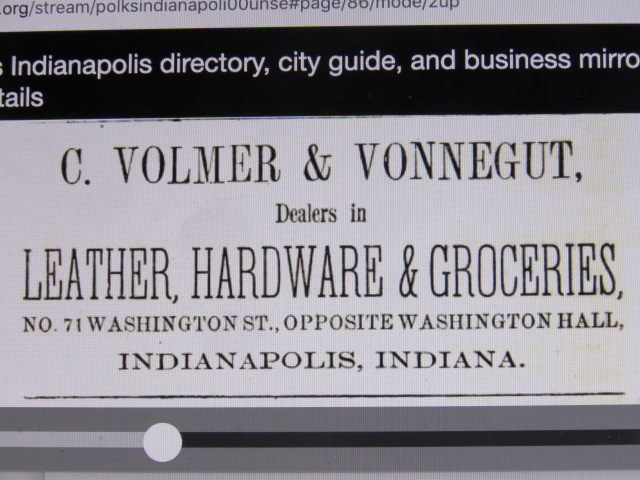
After bushy-bearded Clemens arrived in Indianapolis in 1852, he and his countryman Volmer started a one-room trading post selling hardware, leather goods and groceries. The Volmer-Vonnegut enterprise served the city’s home builders and carpenters but also pioneers headed to the West on the National Road by Conestoga wagon in search of gold, inexpensive farmland, or commerce. Many travelers passed through Indianapolis clutching well-worn, crushed copies of Route Across the Rocky Mountains by Overton Johnson and William H. Winter of Crawfordsville, Indiana, that mapped good places to camp, locations of water holes, and many practical tips for camping and cooking on the Oregon Trail. Even so, many tenderfeet perished without ever reaching Oregon.
The last stop for the wagons before Indianapolis was a 78-acre farm and inn run by a Quaker named John Huddleston. If rooms were booked, strangers often slept with strangers in the rope-bottomed beds that filled the white, three-story house.
The city hardly rolled out a red carpet for the two German merchants. When the outspoken Clemens and Volmer expressed enthusiasm for the 1852 Democratic presidential candidate Franklin Pierce, Whig supporters of candidate Winfield Scott, a general during the Mexican-American War, smashed the store’s windows with rocks, but kept their hands off the proprietors. “Hurrah for Scott, and down with the Dutch,” the mob jeered.
The Indiana State Sentinel newspaper defended Vonnegut and Volmer against the rowdies on October 21, 1852. “These Whig gentry had better look out; they are known and will be marked,” an editor declared. “If freemen cannot exercise the right of suffrage without being insulted and mobbed, it is time the law should interfere. If not there is a law of self-preservation which is above statutes.”
In addition, the Indianapolis marshal collared a petty criminal calling himself Peter McCartney who bought a fifty-cent penknife from Volmer while intending to cheat him. The conman used a counterfeit ten-dollar bill in payment. McCartney walked off with $19.50 in change.
In 1852, Clemens persuaded Katharina Blank, the dark-haired daughter of struggling Hoosier farmers Johann and Anna Blank, to marry him. Clemens had a favorite eating place near his shop where Blank worked as a waitress. Like Clemens, she was small in stature, but she impressed him with her self-educated smarts and talent for languages.
Clemens Sr. and his wife had four sons. They named them Franklin, George, Clemens, Jr.; and Bernard.
 Clemens and Katharina Blank
In 1854, store owners Volmer and Vonnegut moved to a larger building on 8 East Washington street, between New Jersey and Alabama streets, a short walk from the Indianapolis courthouse. The store flanked Little’s Hotel and its livery stable, as well as the nearby Moffitt’s Drug Store and Perfumery. Clemens Sr. lived in a livable flat above the store. The partners now advertised in an Indianapolis directory that they sold leather, hides and shoe findings to the prosperous farmers whose fertile lands rimmed Indianapolis.
The hardware store was situated on a dusty trail on dry days but a muddy sluice after the torrents of May hit. The trail often needed snow to be cleared for passage much in winter. Charles Volmer and Clemens Vonnegut wrote a joint letter to the Indianapolis Council Chamber and Republican Mayor Samuel D. Maxwell on May 22, 1858. They demanded that the city repair the mucky, rutted streets between Alabama and New Jersey streets “that are a disgrace to the city and an injury to the health.”
In response, repair crews with teams of horses filled in the potholes and then dragged a heavy contraption across the road that smoothed the way until the next cloudburst hit.
A.C. Howard’s “Directory for the City of Indianapolis” in 1857, boasted it published “a correct list of citizen’s names.” It listed, incorrectly, a misspelled “Clemence” Vonnegut as a hardware dealer and made no reference to a partner. Thus, it was likely around 1857 that Clemens and Volmer dissolved their partnership, although it may have taken an additional year to untangle loose ends. However, contrary to Vonnegut family myths (noted in the biography by Charles Shields and Kurt’s Palm Sunday based on Uncle John’s account), Volmer did not head for the gold fields immediately. He stuck around for three years before abandoning Indianapolis circa 1861. He either opened a new business after parting with Clemens or continued his former liquor sales. Sutherland and McEvoy’s City Directory and Business Mirror for 1860 listed Volmer as the owner of a wine and liquor wholesale shop on 113 East Washington street. His family resided at 144 West Maryland street.
Volmer made the risky choice to operate a wholesale liquor business at a time Indianapolis was awash with saloons and rival liquor establishments. He moved his failing business over time to at least three different locales. He hired a clerk named Edward Jaenke to oversee the liquor sales in 1860 through part of 1861, according to a city directory.
An 1860 Indianapolis city directory also listed Charles Volmer as secretary of the German Mutual Insurance Company of Indiana. Apparently, in addition to running a store, Volmer took a paying job as an insurance agent to support his family.
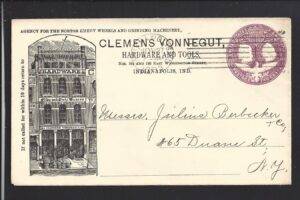
By 1860, Clemens Sr. specialized in buying and selling leather hides, hardware tools and cutlery at his 142 East Washington shop. He was a hustler. His store stayed open by the light of coal oil lamps long past closing whenever customers needed wheelbarrows or emergency supplies. Vonnegut’s even offered a delivery service. Many employees that signed up with Vonnegut eventually stayed with the firm from fifteen to sixty or more years. They pursued leisure time activities sponsored by the store such as a baseball team with uniforms, a band, and a choral group.
For years, a cracker barrel perched on a stand for customers to raid for free, accompanied by cheese and ale. Some customers feared American banks, and Clemens banked their savings. By and by, he also sold caskets and listed himself as an undertaker in an Indianapolis city directory.
Among other Indianapolis civic leaders, Clemens Vonnegut with Hermann Lieber (a relative of Kurt Vonnegut, Jr. on his mother’s side) founded the German-English Independent School in 1858 as an educational institution to honor and preserve German traditions, customs and language. If Clemens and Hermann (frequently spelling his name Herman) had their way, Indianapolis would not remain devoid of music, culture and good schools.
Aware that uncultured Hoosiers mocked the German accent, the school intended to prepare its graduates to assimilate in the New Country. These German business leaders hoped the school’s graduates would cherish the Old Country’s heritage and contributions to civilization, but also become versed in English and American customs. Clemens served for many years as an outspoken member and then chairman of the school board. He occasionally engaged in verbal tussles with those who questioned his decisions.
A legal matter concerning Clemens and Volmer made local news in 1861 after the two severed their partnership. What is known from newspaper accounts is that Volmer lost a civil suit, apparently bruising Vonnegut’s business reputation, as well as his own. Charles Brinkman, a German immigrant, successfully sued Volmer for unpaid debts. As Volmer’s assets then were minimal, Clemens Vonnegut was forced to cover the debt. U.S. census records in 1860 listed Volmer’s combined place of business and personal value at just $2,600.
Indianapolis Sheriff William J. Wallace seized property of former partner Clemens to satisfy the court judgment against Volmer. Clemens endured the public embarrassment of reading his own name in a notice listing the sheriff’s sale published in the Indianapolis Daily Journal on July 22 and July 23, 1861. The sheriff paid the plaintiff Brinkman with the proceeds of the sale.
Likely in 1864, Volmer ended all business in Indianapolis. Kurt, Jr. always accepted the family legend that Clemens Vonnegut’s former partner departed for California to hunt for gold or a fresh start. However, another possibility is that Volmer could have been evading a call to arms for the Union in the Civil War (much like Samuel Clemens who turned his back on the war and headed out west). Records prove that Volmer registered with the Union for the draft.
Clemens never again spoke to his old friend after Volmer departed. The former partner of Clemens Vonnegut left Charlotte Volmer ruined financially with five children to provide for. No known paper trail shows if Volmer made it to the gold fields. An Indianapolis newspaper of the time period speculated that he returned to Germany, but this biographer found no ship voyages by Volmer that back that rumor.
A biographer can only speculate. Perhaps Volmer ran into foul play on a journey. Perhaps he abandoned his wife and children. A published railroad record in a California newspapers did list a “Charles Volmer” as a train passenger soon after he vanished, but that could be another man with that same common name. A search by this author failed to turn up a record of death, so there is no definitive account of Volmer’s fate.
What is known is that three years after Volmer’s disappearance, Mrs. Volmer listed herself as a widow in an 1867 Indianapolis directory. She and her children remained in Indianapolis until 1867 at a flat at 289 North Mississippi Street (later renamed Senate Avenue).
Charles Volmer’s eldest son, also named Charles, helped support his mother and siblings by working as a clerk for Aetna Insurance in Indianapolis. Eventually, Mrs. Volmer took her brood and moved to California to begin a new life.
One son of Charlotte and Charles, Sr. achieved the financial success that eluded the father, Clemens Vonnegut’s friend.
Rudolph Volmer made a fortune purchasing grain from farmers and ranchers in California for resale. He appeared regularly in business articles and also served as a bank director and a Master Mason. Rudolph Volmer died a widower in 1930 after a year’s illness. He willed his business to two sons.
Hello, Readers. I am going to publish teaser sections from my in-progress biography of Kurt Vonnegut in hopes of raising funds to do more interviews in person. If you can help: send to Hank Nuwer, PO Box 73446; Fairbanks, AK 99707. Thank you. HN Kurt…
[Author note: Biographer Charles J. Shields (And So It Goes) and Kurt, Jr. in Palm Sunday incorrectly spell Charles Volmer’s last name as “Vollmer,” contrary to the correct spelling published in multiple nineteenth-century Indianapolis city directories and newspapers. The spelling error, I believe, first appeared in early Indianapolis newspaper accounts of the history of Vonnegut Hardware stores, and came from interviews with Franklin Vonnegut, son of founder Clemens Vonnegut. An Indianapolis daughter of a friend did some research on the Vonnegut family for Kurt, and she repeated the incorrect Volmer spelling in a freelance series of articles for an Indianapolis newspaper.
I have spent long hours reading Indianapolis newspapers of the period to write this part of the history]. HN