
Kurt Vonnegut’s Ancestry: Part One (excerpted from future biography of Vonnegut by Hank Nuwer)
“Kurt Vonnegut: The Man in the Hole. A Life of Reinvention. ” by Hank Nuwer
The Vonnegut family’s earliest forbear in America was Johanna Juliana (Julie) Junghans. She had been the offspring of a poor nailsmith. Julie hailed from Dresden, a fact Kurt Vonnegut, Jr. never fully explored in his writings and interviews. Dresden in the nineteenth-century was a great German city of beauty, art, and culture. It was the city firebombed by Allies in 1945 where young soldier Kurt Vonnegut hid in a slaughterhouse with German guards and fellow prisoners, thereby saving their lives as about 25,000 persons perished.
Julie fell in love with an ambitious lad named Jacob Schramm. He was born January 1, 1805, near Nuremberg,
Jacob was the son of the rich accountant, farmer, and hops merchant Erhart Schramm. Old Erhart wanted his boy to take over his various businesses. “His father appears to have been a hard, unfeeling character,” opined a family historian. “Very early, he sent his son out into the world to learn the butcher’s trade, and in his fifteenth year he sent him to Bohemia, there to carry on the hops business with his brother.”
[Footnote: Stone, Norma M. with notes by Emma Schnull Vonnegut. Letters of Jacob Schramm and Family from Indiana to Germany in 1836. Hanover, New Hampshire: The Dartmouth Printing Cp., 1951]
Disturbed because Julie’s father lacked a dowry, Erhart Schramm refused to bless the union. Undeterred, the defiant Jacob, age 26, married his sweetheart against his father’s wishes.
During a brief period of disinheritance, Jacob determined to support his bride by trusting to fortune and emigrating to America. He paid a friend a large sum to travel to America ahead of the couple and to set up a nest. The friend’s mandate was to purchase suitable farmland in America for Jacob and Julie to farm.
However, before the couple could set sail, Ernest Schramm fell deathly ill. The couple stayed at his death watch. Julie delivered a baby. Ernest embraced the couple and grandchild and restored his son’s inheritance before he died.
Jacob’s economic future was now settled. However, his mind was made up to move from the Fatherland.
Newly wealthy, Jacob settled his late father’s business affairs. He and Julie purchased passage to Indiana in 1835 to start a new life on a farm cabin on former Delaware tribal lands.
Nineteenth-century German immigrants preferred wooded lands similar to their homeland’s forests. Indiana, not yet deforested, was particularly attractive to German newcomers. Jacob paid a trusted friend to scout out Indiana and find prime land for farming.
The couple unloaded their worldly goods fourteen miles from a primitive settlement called Indianapolis, not incorporated as a town until 1832. Indianapolis’ business area had streets and pathways of clay that became treacherous after heavy rains. Piles of horse and cow dung baked on all streets.
With the couple on the ship was their three-year-old daughter Nanni; father-in-law Karl. F. Junghans, a maid, and two young male adventurers in search of a new life. The Schramm family brought hundreds of books in German, plus gold and decorative Dresden porcelain from Meissen, a city near Dresden.
Julie Schramm also brought flower seeds and cuttings of her favorite plant—hollyhocks—to add a sense of Old Country familiarity to Indiana.
Footnote: An ancestor of Julie named Jacob Richard Schramm, Ph.D., acquired her love of flowers and plants, becoming a respected biologist, one-time instructor at Cornell, and later, a research scholar in plant science at Indiana University before retiring at age 89 in 1975.
Upon arrival in a strange land, Jacob learned that his trusted friend’s land purchase for him was in a flood plain. Jacob broke with his false friend George H. Instead of abandoning the acreage, he drained the swamp to plant crops. Eventually, he owned some 2,000 acres according to Vonnegut family history.
Footnote: Laura Long, “Early Pioneers Found Hard Work,” The Republic of Columbus, Indiana, October 22, 1959.
Jacob’s future estate was rich in timber. He and Julie erected a log cabin in a forest glade with a fireplace for heat and cooking. They cut some trees and sold the lumber, but they kept some woods intact. So dark and deep were the woods that the family sometimes unraveled string to guide them back to the cabin.
Those woods remaining today constitute the Jacob Schramm Nature Preserve near Sugar Creek in Hancock County, Indiana.
Julie and Jacob’s child, Mary Mathilde Schramm, married Indianapolis produce merchant Henry Schnull in 1856. Jacob did not want his daughter to ever want. In lieu of a dowry, he established young Henry in the grocer trade. Henry traded goods on the Mississippi River, buying cheap and selling dear back home in Indianapolis. (He bought from farmers in Ohio and Indiana during the Civil War years and avoided the likelihood of being robbed).
In time, Henry and Mary’s daughters, Emma Schull and Nannette Schull, married two sons of the Vonnegut patriarch, Clemens, Sr.
Emma Schnull, the aunt of Kurt Vonnegut, Sr., and the father of the future author, married Clemens Vonnegut, Jr. on September 4, 1878.
Nannette Schnull, a socialite known for her singing in Indianapolis, married part-time geometry teacher and renowned architect Bernard Vonnegut, the grandfather of Kurt, Jr., on September 19, 1883. This union with Nannie Schnull determined that Bernard would now live, work, and rear a family In Indianapolis instead of New York City.
To Be Continued
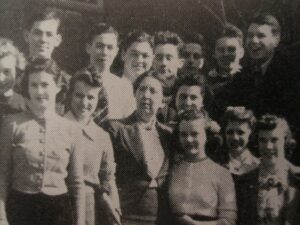 Yearbook photo of Kurt Vonnegut: Can you locate him?
Footnote: Stone, Norma M. with notes by Emma Schnull Vonnegut. Letters of Jacob Schramm and Family from Indiana to Germany in 1836. Hanover, New Hampshire: The Dartmouth Printing Co., 1951
[Footnote Curiously, publisher C.C. Kutschera wrote a preface to the “Letters,” first printed in German, that made it clear his reason for publishing the letters was to discourage other dreamers like the Schramms from emigrating to America. He warned readers that great perils awaited them in Indiana. Nein, Reader, better you content yourself with life and culture in the German Fatherland. [Stone, Norma M. with notes by Emma Schnull Vonnegut. Letters of Jacob Schramm and Family from Indiana to Germany in 1836. Hanover, New Hampshire: The Dartmouth Printing Cp., 1951
Footnote: The letters were published as a book in 1837 in the ancient Bohemian city of Žatec—also known as Saaz in German—in a hops-growing part of the world that today is part of the Czech Republic. Two of their descendants, Mrs. Clemens Vonnegut, Jr., and Norma Mueller Stone, a great-granddaughter of the Schramm’s, translated the letters.
Hello, Readers. I am going to publish teaser sections from my in-progress biography of Kurt Vonnegut in hopes of raising funds to do more interviews in person. If you can help: send to Hank Nuwer, PO Box 73446; Fairbanks, AK 99707. Thank you. HN