

By Hank Nuwer: The details and facts in this essay were taken from testimony delivered by members of KAS on October 12 and October 16, 1873, at a two-day coroner’s inquest in Ithaca, New York,. Charles Wason.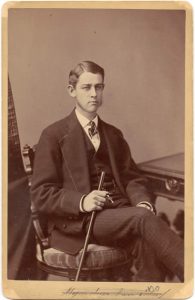 .
.
Mortimer Marcellus Leggett arrived at Cornell University in September of 1873. The next month he would die, the first fraternity member to perish during his initiation.
Mort had traveled by train from Washington to Ithaca with his muscular, bushy-bearded father.
The youth’s dream after graduation was to join that father, General Mortimer Dormer Leggett, in the practice of patent law.
The two found Mort lodging at a well-appointed house owned by a Mrs. Girard at 16 South Aurora Street.
Mort’s father was familiar with Ithaca, having grown up in the village before moving
As a teen to a family farm in Ohio. A Quaker, the elder Leggett was no pacifist, but
true to his sect he refrained from alcohol and tobacco. The elder Leggett was a celebrated
Civil War warrior who distinguished himself at the battles of Shiloh, Corinth and Atlanta.
Young Leggett selected Charles F. Clark, also an abstainer from alcohol and tobacco to be his roommate. Reassured that his son was safe at a school that prided itself on religious education, Mortimer D. Leggett returned to Washington, D.C., to his post as commissioner of the U.S. Patent Office.
As September moved into October, “traditional” hazing by upperclassmen was on the minds of all freshmen. Many newcomers had heads shaved, buttocks paddled, and head ducked under a water pump.
In fact, the faculty banned the class rush because of recent injuries.
It had been Cornell President Andrew Dickson White who encouraged the formation of fraternities at his institution.
In early October, Kappa Alpha Society became interested in recruiting Mort. KAS was the first social fraternity, founded at Union College in New York in 1825. Charles Wason was the initial member to befriend “Mort” after his enrollment.
Members of the Cornell chapter assured Mort Leggett that the Society was known for oratory brilliance, academic excellence and stunning success later in life. The roll of loyal alumni included statesmen, authors, military geniuses and judges.
Getting an invitation to join a prestigious fraternal organization was a heady, butterflies-in-the belly opportunity for Mort.3
The excited Mort wrote his parents to tell them about this development. “He spoke in the highest terms of the character of the young men at Cornell who belonged to [KAS], and said that its rules prohibited its members from using strong drink in any form, and from the use of profane and obscene language, and had in view only social and literary culture. We gave him our full consent to become a member,” the elder Leggett later would state. 2
The Cornell chapter of Kappa Alpha Society, established a series of preliminary challenges for prospective members. The first was scheduled for October 10, 1873, and its members justified Leggett’s first challenge to be nothing more than a long walk in the country, not hazing.
Wason made several visits to Mrs. Girard’s boarding house to get to knowLeggett. Wason was a sturdy man of twenty-three whose side whiskers made others take him for older than he was.
On the evening young Leggett began pledging, Kappa Alpha Society member Henry Northrup called on Mort at Mrs. Girard’s. Mort was alone; his roommate Charles Clark had departed for a Presbyterian service.
Northrup and Leggett walked to the large white boarding house on 113 East Green Street that housed several KAS members. Leggett changed clothing into rougher attire, because he expected to endure some challenging “preliminaries” to initiation. KAS brothers expected him to “earn” his membership by accomplishing certain physical feats that all Cornell Kappas had undergone.
Next thing, Leggett and Northrup went on a tiring walkabout on Ithaca’s hilly streets. They went along Green Street to Cayuga, to Clinton Street, to Aurora, Hudson and Giles—the latter at the edge of town where Cornell’s famous gorges drew tourists. Leggett passed impressive gorges and spectacular waterfalls that had been formed by glaciers during the Ice Age.
Around 9 p.m., about nine Kappas and one pledge headed from Ithaca toward the rough country near Giles Street with plans to meet Northrop and Leggett.
Member Charles H. Lee was the first to catch up with Northrup and Leggett. Three weeks earlier, Lee himself had passed all preliminaries and been initiated into the Society. The three paused at a fence, and the next preliminary ritual commenced.
Northrup, with Lee’s approval, blindfolded Leggett and then helped him get over the fence into a field appointed for additional rituals.
Not long after the blindfold went on, KAS members Wason and William Sturges vaulted the same fence and also approached Leggett, Lee and Northrup at the rendezvous point. Wason and Sturges had been here in this appointed field several times previously with pledges that now were initiated members.
Thus, this was a planned chapter event, albeit one without gravity or merit if witnessed in the eyes of outsiders. However, Cornell KAS men who cherished fraternity membership all their lives regarded it as nothing less than a dignified ceremony they would reminisce about as old men.
Usually, at this point, two Kappas were supposed to link arms with the pledge so that he didn’t trip or fall over potholes and rocky dodges. But Wason, one of the strongest members, alone linked Leggett’s arm in his, although Lee was close at hand. Wason saw a hemlock tree and decided he’d take Leggett over to rest up against it for the grueling preliminaries that remained. Lee followed.
The lone hemlock’s roots were misshapen, bulging and ready to trip interlopers. The tree’s leafy lower limbs resembled small bushes that blanketed the roots.
Blindfolded pledge Mortimer Leggett leaned against the tree with the two society members at his side.
As with other hazing incidents, when a death occurs both reckless disregard and the absence of common sense are to blame. Neither of the two brothers with Leggett carried a lantern to a dangerous gorge area lit only by moonlight. Had Wason and Lee brought anoil lamp, they would have spotted the yawning gorge hidden behind the hemlock and backed away.
Leggett knew not where he was, nor precisely what brothers expected of him. He assumed that he was in good hands. The blindfold was part of a trust-building exercise.
Lee, later described by a New York reporter as a beardless and handsome lad of 20, observed that the pledge appeared tired after the traditional long pledging walk.
Wason also saw Leggett slump from fatigue. He sprang to give the pledge a helping shoulder. Leggett, unable to see through the blindfold, took a step toward the sound of tree limbs cracking under Wason’s footgear.
Lee watched his companions begin to sink through the leaves. He threw out his arms to save them, concluding that a ledge must lie beneath the canopy of leaves and roots.
Instead, Lee dropped through the tree leaves and over the hidden cliff wall, the bodies of Wason and Leggett flailing in the air beneath him.
The trio plunged more than forty feet to the hard ground. Wason later described the sensation in testimony as feeling as if he were swinging on a swing.
Wason’s body was the first to slam into the earth. He heard “two distinct thuds” as
Lee and Leggett landed almost atop him. Wason tried to scream but the air in his lungs had been knocked out.
Leggett landed headfirst on the stony clay. The impact created an indentation the size and shape of his head that someone unknown later marked with stakes to preserve the impression.
The pledge managed a few words. “Oh, don’t,” he murmured.
Wason had struck land with his feet first and bounced, smashing a
collarbone. Lee had landed on his side, severely bruising a hip and possibly incurring internal injuries; had he dropped any farther and faster he would have shattered his hipbone.
Leggett’s traumatic brain injury was apparent, and he likely had ruptured blood vessels beneath the scalp. All three young men had traveled at similar velocity, but Leggett’s body had assumed the cruelest, most punishing angle of trajectory. The inches-deep indentation where his head had struck the packed earth displayed the deadly effect of sudden deceleration and trauma.
Rescuers took Leggett to Ithaca.
Within thirty minutes of arrival at the Kappa headquarters, Leggett’s moans ceased. Doctors closed Leggett’s eyes around 11 p.m. and pulled a sheet over him.
The Cornell Era student newspaper of October 17, 1873, would term the incident “thesaddest accident that the Era has ever been called upon to chronicle.”