
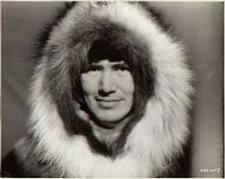
Last Frontier Days
By Hank Nuwer
Right from the start, a man rarely had more strikes against him than did Ray Wise Mala.
For starters, he was born Ray Wise in the mining town of Candle on the Seward Peninsula. That’s about 140 miles northwest of Nome. Snow drifts in winter can bury a cabin right up to the stovepipe when the winds whip up.
His father was a Russian trader and miner. His mother was a full-blooded Alaska native. The marriage of his parents blew up when he was a tyke.
He was an unwanted kid, but his maternal grandmother Nancy Armstrong reared him as best he could, and he learned to hunt, fish, and use his fists against the bullying tough sons of tough local miners. He learned his lessons from visiting missionaries.
He left home in 1920 and took whatever labor jobs paid his bills. He drifted to California where his big break came in 1926 when director and cinematographer Frank E. Kleinschmidt hired him to work as an assistant camera operator for an Arctic documentary called Primitive Love: A True Story of Life and Love Among the Eskimos, according to the American Film Institute Catalog.
He loved the work, and in fact, would work as a camera operator right up to 1940, according to Census records. That is when he wasn’t starring in films.
One other lucky break was that he was dark, a brawny six-footer, and handsome with light brown skin.
A writer-director named Ewing Scott hired him as a cameraman for a documentary on Eskimo life to be called Igloo. When Scott clashed with the film’s intended star, he hired the handsome Wise to take the part of a native hunter.
The documentary was filmed over a seven-month period in and around Point Barrow in 1931.
Here, I throw out the caveat that Ewing Scott and producer Edward Small decided to get creative with Wise’s biography, portraying him basically as someone who stepped out of an igloo into stardom.
Naturally, there was backlash and criticism when reporters learned he had Russian family roots and was already a veteran film crew member.
So, when the film came out, the star’s film was dubbed “Chee-Ak” on posters and hyped news releases.
But “Chee-Ak” weathered the bad publicity.
The New York Times described the film as technically rough but raved about the documentary’s dramatic incidents and male lead.
“The leader of them (the Eskimos), Chee-Ak, is a good-looking young man who fills his role with bland unconcern,” noted the reviewer.
The Jersey (City) Journal described the hero “as a veritable Sheik of the North.”
Typecast at that point, he next appeared as an actor in a film titled Eskimo based on the writings of explorer Peter Freuchen. He took the screen name of Mala, also known as Ray Mala, although some media stories also had his name as Ray Wise Mala.
Around 1932 or 1933, Mala declined to play an Eskimo again.
“My agent and I decided not to let them do that to me,” Mala told the Los Angeles Evening Citizen News some years later. “We felt I could do many things besides play an Eskimo. So, we put the ban of further Eskimo roles.”
In quick succession, Mala played a south sea islander, a jungle he-man, an American G-Man, and an Indian warrior in Cecil B. DeMille’s 1939 Union Pacific.
He relented once he became well known and acted in Girl from Alaska and the 1932 thriller Red Snow, also set in Alaska.
When he wasn’t acting, Ray Wise Mala readily accepted work as a cinematographer and assistant camera operator, notably for Alfred Hitchcock in the 1943 thriller Shadow of a Doubt.
Altogether, he acted in more than two dozen movies.
He was married twice, briefly as a young man and then in a long-lasting relationship with wife Galina Bliss. His two children were Ted Mala Jr. and Galina Mala Liss.
Sadly, he died of a heart attack in 1952 and was buried in Hollywood. He was only 46.
His son long hoped to bring his father’s remains back to Alaska. He succeeded in doing so in 2018.
Time Magazine ranked Ray Mala as one of its Top Ten Alaskans.
Columnist Hank Nuwer has had his own brushes with documentary film-making. He’s appeared in the 2008 documentary Haze in 2008 with Robin Wright and more recently in director Byron Hurt’s documentary Hazing. This year he appeared as the character Arnold Marsh in the 2025 short film Strange Embrace. This column was first published in the Cordova Times